South Asian Metabolic Health · Registered Kinesiologist Reviewed
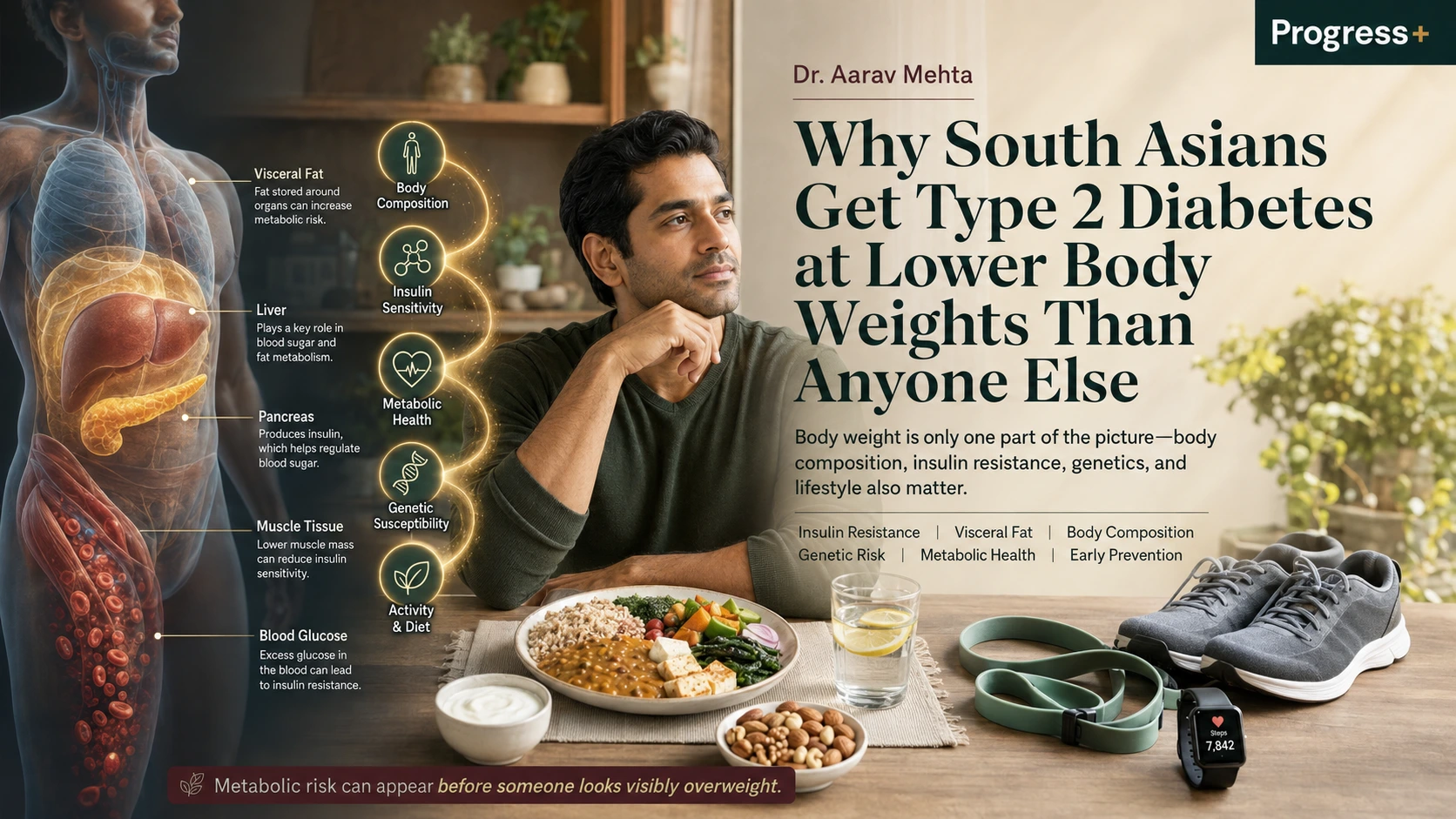
Why South Asians Get Type 2 Diabetes at Lower Body Weights Than Anyone Else
By Kartik Thakkar, Founder & CEO · Reviewed by the Progress+ Registered Kinesiologist team · 14 min read
Summary
If there is one thing worth taking away from all of this, it is that "normal weight" does not mean "no risk" for South Asian bodies, and that is not a scare tactic, it is what the research consistently shows. A smaller capacity to store fat safely, fat that ends up in the liver and muscles instead of under the skin, lower muscle mass, a pancreas that is already working harder than it should, and genetics that are only now being properly studied, together these explain why so many South Asians are told their numbers are "fine" right up until they are not.
The reassuring part is this isn't a mystery anymore, and it isn't something you're dealing with because of anything you did wrong. It's a pattern that has been documented in Ontario, in Vancouver, in the UK, and globally, consistently enough that health organizations have already changed their own guidelines to reflect it. That kind of consistency is exactly why we trust this research enough to build a program around it.
And it is also not a life sentence. The mechanisms driving this, low muscle mass, fat stored in the wrong places, respond well to the right kind of movement, done consistently, under the right guidance. That is really the whole point of sharing this, not to alarm you, but to make sure you are working from accurate information instead of a chart that was never built with your body in mind.
If any part of this sounded familiar, a normal BMI but numbers that concern you, or effort that does not seem to show up on paper, that is worth a real conversation, not just another generic "eat better, move more." We would genuinely welcome that conversation with you.
Key Takeaways
A "normal" BMI does not mean "no risk" for South Asians.
A South Asian person with a BMI of 22 can carry the same diabetes risk as a white European person with a BMI of 30. The number on the scale tells a very different story depending on your background.
This is biology, not a personal failing.
The thin fat phenotype, normal weight with disproportionately high internal fat, is present from birth. If you have been doing "everything right" and still seeing concerning numbers, it was never about a lack of willpower.
Your body stores fat differently, and that matters.
South Asian bodies tend to have less capacity to store fat safely under the skin, so extra fat gets pushed into the liver, around organs, and into muscle tissue instead, and that is where the real metabolic damage happens.
Exercise can feel like it is "not working" for a real, physiological reason.
Fat that builds up inside muscle tissue interferes with muscle's ability to absorb blood sugar. This is why so many people can be active and still struggle with their numbers, and why the right type of exercise matters more than just "more" exercise.
Your pancreas may be working harder than you realize.
Beyond insulin resistance, many South Asians also deal with reduced insulin producing capacity in the pancreas itself. Some researchers now believe this may be the bigger driver of the two.
The genetics are real, and the research is catching up.
A 2024 study found specific genetic markers tied to earlier diabetes diagnosis and lower BMI at diagnosis in South Asian populations, confirming what many families have long suspected from their own history.
The BMI chart you grew up with was not built for you.
The WHO and India's own health ministry have already adopted lower BMI cutoffs for South Asians. 23 is considered overweight, 25 is considered obese. It is worth knowing your real number.
This risk is well documented right here in Canada.
Research out of Hamilton, Ontario, and Metro Vancouver confirms this is not just an overseas statistic, it is showing up in the same communities many of us live in.
Being vegetarian is not automatic protection.
Refined carbohydrates such as white rice, refined roti, fried snacks, and sweets can drive the same risk regardless of whether meat is on the plate. It is worth looking at what is actually on the plate, not just whether it includes meat.
The right kind of movement genuinely helps.
Structured resistance and strength training, done under proper supervision, directly addresses the muscle and metabolic mechanisms behind this risk. This is not a life sentence, it is a pattern that responds well to the right approach, and that is genuinely good news.
Introduction
Priya's mother had been telling her for years that she looked "too thin to worry about." So when her doctor flagged elevated blood sugar at a routine checkup, she was genuinely confused. She was not overweight. She walked most evenings. She had never smoked, rarely drank, and cooked most of her own meals. On paper, she looked like someone with nothing to worry about.
If that story sounds familiar, if you have stepped on a scale, seen a number that is supposed to mean "healthy," and still been told your blood sugar needs attention, you are not imagining things, and you are far from alone. This is one of the most quietly misunderstood health realities in the South Asian community, and it deserves a real explanation, not just a warning.
Here is the stat that tends to stop people mid sentence. According to a UK Biobank analysis, a South Asian person with a BMI of 22, solidly inside the "healthy" range on every chart most of us have ever seen, carries the same risk of developing type 2 diabetes as a white European person with a BMI of 30, which sits well into the obese category. Not a similar risk. Not a slightly higher risk. The same risk.
South Asians are three to five times more likely to develop type 2 diabetes than the general population, and they are typically diagnosed five to ten years earlier than white Europeans. And this is not a statistic happening somewhere far away. It is showing up in Brampton, Mississauga, Milton, Burlington, Scarborough, and in nearly every South Asian household across the GTA and Waterloo Region, often in people who, like Priya, did everything they thought they were supposed to do.
So what is actually going on? Why does "normal weight" mean something so different for a South Asian body than it does for almost anyone else's? The honest answer has nothing to do with willpower, how disciplined your diet is, or how often you show up at the gym. It is biology, specific, well documented biology. And once you understand what is actually happening beneath the surface, a lot of confusing, frustrating experiences suddenly start to make sense.
What Is the Thin Fat South Asian Phenotype
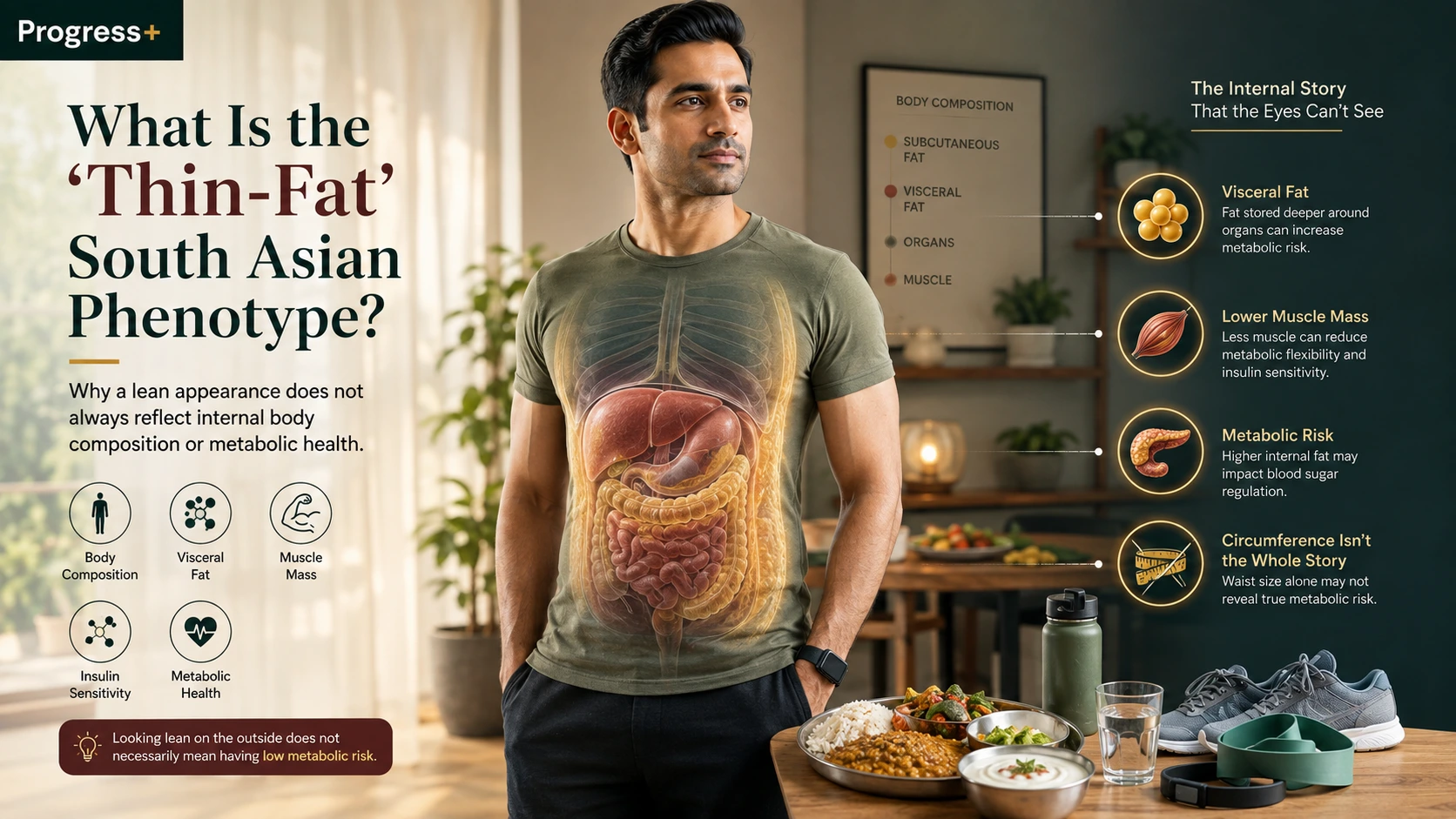
Researchers have a name for this pattern, the thin fat phenotype. It describes a body that looks lean or "normal" on the outside, normal or even low BMI, but is carrying a disproportionately high amount of body fat, especially around the abdomen and internal organs.
The thin-fat phenotype: a lean external appearance can hide visceral fat, liver fat, and lower muscle mass.
This is not something that develops over years of bad habits. It is visible from birth. Studies comparing South Asian and white European newborns have found that South Asian babies tend to have lower birth weight but higher body fat percentage, something you can actually see on DEXA body composition scans. Dr. C.S. Yajnik, the researcher who coined the term "thin fat Indian," was one of the first to document this pattern clearly.
This matters because it reframes the whole conversation. This is not a personal failing. It is not that South Asians are "doing something wrong." It is a body composition pattern that starts before you are even born, and it changes what "healthy" actually looks like for this population.
The Four Real Reasons This Happens
Most articles on this topic stop at "insulin resistance" and move on. That is only part of the picture. Here is what is actually happening underneath the surface.
Limited storage space, and where the overflow goes
Think of fat storage like a parking garage. Everyone has a "safe" parking area right under the skin, subcutaneous fat. It is not ideal to have a lot of it, but it is relatively low risk.
South Asian bodies tend to have a smaller garage. Less capacity to expand that safe, under the skin storage. So once that limited space fills up, the extra fat does not just disappear, it has to go somewhere. It ends up parking illegally, in the liver, wrapped around internal organs, and even inside muscle tissue. This is called ectopic fat deposition, and it is directly toxic to how insulin functions in the body.
There is a striking study out of the University of Glasgow that proves this in real time. Researchers had South Asian and white European men gain a controlled 5 kilograms of weight. In the white European men, insulin sensitivity dropped by about 7 percent. In the South Asian men, it dropped by 38 percent. Same weight gain, wildly different metabolic consequence.
Why your workouts might not be "working"
This is the one nobody talks about, and it might be the most important piece for anyone who is frustrated that their numbers will not move despite genuinely trying.
Muscle and the brain are two of the only tissues in the body that can absorb blood sugar without needing much help from insulin, which is a big part of why exercise is usually so effective for blood sugar control. But when fat builds up inside the muscle tissue itself, called intramyocellular fat, it interferes with that process. The muscle becomes less able to soak up glucose, even if you are exercising regularly.
This is exactly why so many South Asians say some version of the same thing. "I walk every day, I eat reasonably well, and my A1c still won't budge." It is not that the effort is not real, it is that the type of exercise matters. Building metabolically active muscle through resistance and strength training addresses this mechanism far more directly than cardio alone.
A pancreas that is already working overtime
There is a second issue happening alongside insulin resistance, and it is arguably just as important, beta cell dysfunction, sometimes called beta cell blunting.
Insulin resistance means the insulin your body makes does not work as well as it should. Beta cell dysfunction is a separate problem, it means the pancreas itself may have a reduced capacity to produce insulin in the first place. Emerging research suggests South Asians may be dealing with both problems at once, and some researchers now believe this reduced insulin producing capacity might actually be the primary driver of diabetes in this population, not just a side effect of insulin resistance.
The genetics are catching up to what we have long suspected
This part of the picture is genuinely new. A study published in Nature Medicine in late 2024 looked at British Pakistani and Bangladeshi individuals and found specific genetic risk scores tied to insulin deficiency and unfavorable fat distribution. People carrying high genetic risk on both fronts were diagnosed with type 2 diabetes 8.2 years earlier, and at a BMI roughly 3 points lower, than those with lower genetic risk. The same research confirmed that South Asians carry a meaningfully higher genetic burden for these specific traits compared to white Europeans.
In plain terms, this is not just lifestyle, and it is not just a vague "cultural" explanation. There is real, current genetic evidence behind why this population develops diabetes earlier and at lower weights.
What Your BMI Number Should Actually Be
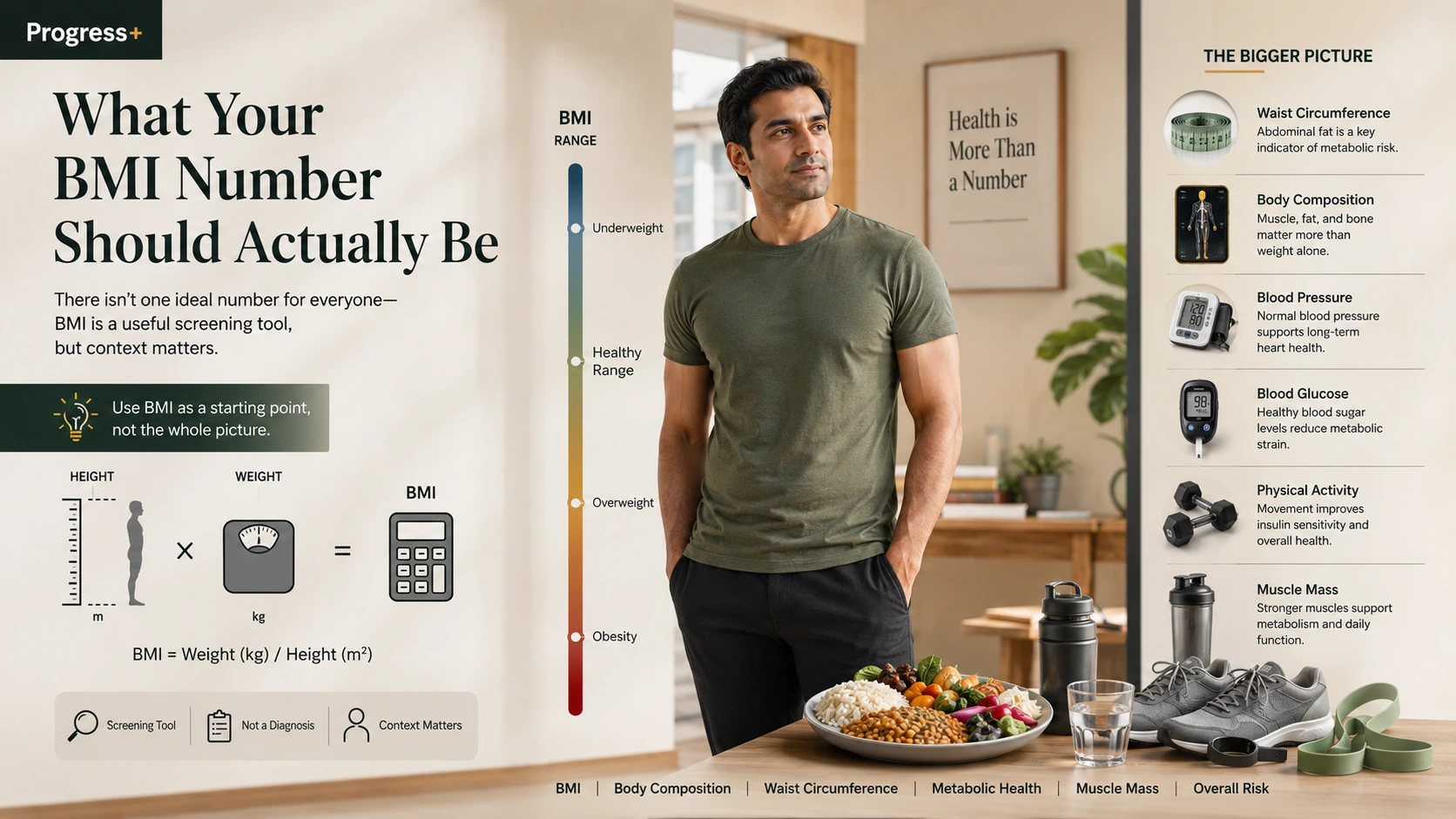
Here is the part almost nobody puts in front of you clearly. The standard BMI chart most doctors and most people use was not built with South Asian bodies in mind. The World Health Organization, along with India's own Ministry of Health, has already adopted lower cutoffs specifically because standard thresholds miss risk in this population.
South Asian BMI classification compared to the standard chart most people grew up with.
For South Asians, the numbers look like this. Normal weight is 18.5 to 22.9. Overweight is 23 to 24.9. Obese is 25 and above.
Compare that to the standard chart most of us grew up with, where overweight does not start until 25 and obese does not start until 30. That gap is exactly why so many South Asians are told they are "fine" by a chart that was never designed for them.
Why This Hits Harder in Canada
This is not just an international research finding, it is a documented pattern right here in Ontario and across Canada.
Research out of Hamilton Health Sciences and McMaster University, part of the SHARE study, found that South Asians had twice the rate of type 2 diabetes and cardiovascular disease compared to Europeans, despite having similar BMI and waist circumference. Similar body size, double the risk.
A separate Ontario based cohort study using Statistics Canada data found that the average BMI at the time of diabetes diagnosis was 29.6 for South Asians, compared to 33.4 for non Hispanic white Canadians. That is a meaningful gap, and it is Ontario specific data, not just something happening overseas.
Physical activity tells a similar story. A Metro Vancouver study found that only 34 percent of South Asians in Canada were even moderately physically active, the lowest of seven ethnic groups studied. And community health campaigns out of the Fraser Valley have reported that South Asians are three times more likely to have diabetes than the average Canadian, with close to half of all cases going undiagnosed.
There is also a myth worth clearing up directly. Being vegetarian does not automatically protect you. South Asians have among the highest rates of vegetarianism in the world, yet a British Columbia dietary study found that South Asian vegetarians in Canada still carry high cardiovascular and diabetes risk. The reason usually comes down to what the vegetarian diet actually consists of. White rice, refined roti, fried snacks, and sweets can drive the same blood sugar spikes as any other refined carbohydrate heavy diet, regardless of whether meat is on the plate.
What Actually Helps
Every article on this topic tends to end the same way, talk to your doctor. That is not wrong, but it is incomplete, and it leaves out the part that actually changes outcomes.
Since so much of this comes down to reduced muscle mass and muscle's impaired ability to absorb glucose, the most targeted intervention is not a vague instruction to "move more." It is building metabolically active muscle through properly structured resistance and strength training. This is a genuinely different exercise prescription than what most generic fitness advice recommends, and it directly addresses the mechanism we talked about earlier.
Supervision matters here too. Many South Asians starting this kind of training are managing joint issues, PCOS, years of sedentary work, or simply unfamiliarity with strength training as a concept, not because of a lack of discipline, but because gym culture and structured exercise were never part of the picture growing up or after immigrating. Getting the intensity, progression, and form right under the guidance of a Registered Kinesiologist is not a luxury in this context, it is the difference between a program that actually moves the needle and one that does not.
It is also worth knowing that programs supervised by a Registered Kinesiologist may be insurance eligible or tax credit relevant in Canada, which is a detail that is easy to miss but genuinely useful when you are weighing your options.
You can also read our broader diabetes prevention resource for the applied programming side of this, tailored to the GTA and Waterloo Region.
Frequently Asked Questions
Can a thin South Asian person get type 2 diabetes?
Yes, and it is more common than most people realize. Because of the thin fat phenotype, many South Asians carry high levels of visceral and liver fat despite a normal or low BMI, which puts them at real risk even at a healthy looking weight.
Why do South Asians get diabetes at a lower BMI than other groups?
It comes down to a combination of factors. Limited capacity to store fat safely under the skin, a tendency toward fat building up in the liver and muscles instead, lower muscle mass, reduced insulin producing capacity in the pancreas, and specific genetic risk factors, all of which shift the risk curve to a lower body weight.
What is the thin fat phenotype?
It is a body composition pattern common in South Asians where someone has a normal or low BMI but a disproportionately high body fat percentage, particularly around the abdomen. It is present from birth and is not the result of lifestyle choices.
Is a BMI of 23 considered overweight for South Asians?
Yes. The World Health Organization and India's Ministry of Health have both adopted lower BMI cutoffs for South Asians, classifying 23 to 24.9 as overweight and 25 or above as obese, compared to the standard 25 and 30 thresholds used for the general population.
Why isn't exercise lowering my blood sugar even though I work out regularly?
This is often related to fat that has built up inside the muscle tissue itself, which interferes with muscle's ability to absorb blood sugar. The type of exercise matters. Resistance and strength training that builds metabolically active muscle tends to address this more directly than cardio alone.
Does being vegetarian protect South Asians from diabetes?
Not automatically. Research from British Columbia found that South Asian vegetarians in Canada still carry high diabetes and cardiovascular risk, largely because of refined carbohydrate heavy diets like white rice, refined roti, and sweets.
What risk factors should prompt earlier diabetes screening for South Asians?
A BMI above 23, a first degree relative with type 2 diabetes, a family history of diabetes combined with heart disease or high triglycerides, and a personal history of PCOS or gestational diabetes are all reasons to ask for earlier screening than standard guidelines recommend.
Can type 2 diabetes risk be reduced through exercise alone?
Exercise plays a major role, but the type matters. Structured resistance training that builds muscle mass tends to be more effective for this population than general activity or cardio alone, especially when it is part of a supervised, medically informed program.
None of this is about blame. Your body is not failing you, it is working exactly the way South Asian bodies have adapted to work over generations, in a modern environment that looks nothing like the one those adaptations were built for. The encouraging part is that this is genuinely modifiable. It just requires the right information and the right kind of movement, not more willpower.
If you are based anywhere across the GTA or Waterloo Region and you are wondering what a program built specifically around this risk profile actually looks like, our Registered Kinesiologists at Progress Plus work with clients on exactly this, in home, one on one, and built around your numbers, not a generic template.
About the Author
Kartik Thakkar
Founder and CEO, Progress+
This article was written and reviewed by the team at Progress Plus, a Registered Kinesiologist led personal training practice serving families across the Greater Toronto Area and Waterloo Region, under the direction of Kartik Thakkar.
We work with clients in their homes, week after week, and a lot of what is written above did not come from a textbook first, it came from conversations. Clients who have told us they eat well, they walk regularly, and they still do not understand why their doctor is concerned. Clients who were surprised to learn that the BMI chart they had been measuring themselves against for years was not actually built with their body type in mind. That is the gap we set out to close with this piece, taking research that is usually locked away in medical journals and putting it in front of the people it is actually about, in language that respects their intelligence without requiring a medical degree to understand it.
Every program we build is supervised by a Registered Kinesiologist, which means the exercise recommendations you read about here are not generic fitness advice, they are grounded in the same clinical understanding of muscle, insulin, and metabolic health that shaped this article. We are not a general gym or a one size fits all training app. We are a small, credentialed team that specializes in exactly this, helping South Asian and other high risk clients build the kind of strength and metabolic health that actually moves the needle, safely, in their own homes.
We know health content online can feel either overly clinical or overly simplified, and that neither version is much help when it is your own numbers on the line. Our goal with everything we publish is to sit in the middle, accurate enough to trust, clear enough to actually use.
If you would like to talk to someone directly about what a program like this could look like for you, you can reach our team through progressplus.ca. We would be glad to have that conversation.
Conclusion
If you have read this far, chances are something in this article felt personal. Maybe it was the BMI number that never quite made sense. Maybe it was the frustration of eating well and exercising and still hearing concern in your doctor's voice. Maybe it was just relief, finally seeing something put into words that you had felt for years but never had a name for.
Here is what we hope you take with you. None of this happened because you did something wrong. Your body is responding exactly the way generations of South Asian bodies have adapted to respond, shaped by biology long before it was shaped by any lifestyle choice you have made. That is not an excuse to ignore the risk, it is the reason the standard advice so often falls short, and why a different, more informed approach actually matters here.
The research is clear, it is consistent across countries, and it is specific enough now that we can point to exactly what is happening inside the body and exactly what helps. That is not something we are guessing at. It is why organizations like the WHO have changed their own guidelines, and it is why we have built our approach at Progress Plus around this understanding rather than a generic template.
So if any part of this resonated with you, a number that does not add up, effort that does not seem to show, or simply a family history that has made this feel inevitable, please know that it is not. This is one of the more genuinely modifiable health risks out there, once you are working with the right information and the right kind of support.
We would rather you have this conversation with someone who understands your body specifically than not have it at all. If you are anywhere across the GTA or Waterloo Region and you would like to talk through what this could look like for you, our Registered Kinesiologists at Progress Plus are here for exactly that. No pressure, no generic script, just a real conversation about your numbers, your history, and what actually makes sense for you.
Start a Real Conversation
Book a complimentary assessment with a Registered Kinesiologist. No cost, no commitment, just a proper look at your numbers and your history, and a straightforward plan built for a body like yours.