Summary
Two or three strength sessions a week can undo a lot of what a desk job does to your body. This guide shows you what sitting weakens, why lifting works better than stretching alone, how to read the signals your body is giving you, and how to follow an 8 week plan that fits a busy Markham workweek.
Key takeaways
- Hip, upper back and shoulder complaints often trace back to long hours of sitting.
- Canada's 24 Hour Movement Guidelines ask adults to strengthen their muscles at least twice a week and keep sedentary time to 8 hours or less a day. Most of us sit far longer.
- Chair and desk exercises help circulation, but they can't challenge your muscles the way real strength training does.
- Start with six movements: hinge, squat, row, press, carry and core. Train them in two or three sessions of 30 to 50 minutes.
- Add three minute strength breaks between meetings. Small, frequent doses count.
- Fill in a screening form before you start. If you feel chest pain, dizziness or numbness, or your pain keeps getting worse, talk to your doctor first.
- Strength training is the strongest foundation, not a stand alone cure. Pair it with walking, a better desk setup and good sleep.
Introduction
It's 3:10 on a Wednesday. You've been in the same chair since lunch, your neck leans toward the monitor, and your hips feel stuck at a right angle. You still have two calls, a code review and a GO train home. If that sounds familiar, your body is telling you something.
It's telling you it needs more strength, and the best time to start is now. You don't need a complicated program. A few simple exercises, done consistently, can have a big impact. In this guide you'll learn what long sitting does to your body and how to build strength with an 8 week plan.
Quick answer
Desk workers can build strength with two or three sessions a week of up to an hour. Focus on hinges, squats, rows, presses and carries to train your glutes, upper back and core. If you have any health concerns, talk to your doctor before you start any strength training routine.
What prolonged sitting does to desk workers
Canadian adults spend a large share of their waking day sedentary, according to the ParticipACTION report card. Canada's 24 Hour Movement Guidelines ask adults to keep sedentary time to 8 hours or less, with no more than 3 hours of recreational screen time. A tech job makes that limit easy to blow past, and Markham is full of tech jobs. In a 2020 interview, Markham's mayor described the city as Canada's high tech capital, with over 1,500 tech and life sciences companies.
Long sitting changes how your muscles work. Some stay short and tight. Others go quiet. Over months, that creates muscle imbalances, which is why the same aches show up again and again. Here are the common weaknesses in desk workers, with the plain reason behind each.
| Where you feel it | What is likely happening | What helps first |
|---|---|---|
| Stiff hips when you stand up | Tight hip flexors and hamstrings from hours in a bent position | Hip hinges, glute work, hip extension drills |
| Low back ache after long sitting | Weak glutes and core, so your back does extra work | Glute bridges, Romanian deadlifts, dead bugs |
| Tension between your shoulder blades | A rounded upper back and rounded shoulders from screen reach | Rows, face pulls, thoracic mobility |
| Neck tension by mid afternoon | Forward head posture as your head drifts toward the screen | Rows, carries, a higher monitor |
| Stiff squat or heavy feeling legs | Limited ankle and hip mobility | Ankle rocks, hip stretches, bodyweight squats |
Try this two minute desk check
This is not a medical test. It just gives you a starting point.
- Count your sitting. Add up the hours you sit on a normal workday, including the commute.
- Do 10 chair stands. Stand up from a chair without using your hands. Notice if your knees wobble or your back grabs.
- Do a wall check. Stand with your back to a wall and your heels a few inches away. Notice whether your head, shoulders and hips can touch the wall without strain.
- Rate your stiffness. Score your neck, upper back and low back from 1 to 10 at 3 pm. Write the numbers down. You'll compare them in week 8.
Tight hip flexors and hamstrings
Your hip flexors stay shortened in a chair. When you stand, they can tug on your pelvis and make your lower back work harder. Tight hamstrings often join in.
Weak glutes and core
Your glutes are your biggest muscles, yet they do almost nothing while you sit. Many people feel their glutes not firing when they climb stairs or squat. A tired core adds to the problem because your spine gets less support.
Rounded shoulders and a rounded upper back
Reaching for a keyboard and leaning toward a screen stretches the muscles between your shoulder blades. Your chest muscles tighten to match. That's how a rounded upper back builds up.
Forward head posture, neck tension and headaches
When your head drifts forward, your neck and upper back take extra strain. Many people feel it as neck tension by mid afternoon. Headaches have many causes, so see your doctor if yours are frequent or severe.
Low back pain
Back pain from sitting rarely comes from one muscle. Weak glutes, a tired core and stiff hips often share the blame. That's why a full body plan works better than chasing the sore spot.
Stiff thoracic spine, hips and ankles
Your upper spine, hips and ankles lose range when you rarely move them. Poor thoracic mobility makes rows and presses feel awkward. Limited hip extension and ankle mobility make squats feel cramped.
Why strength training is the strongest fix for desk workers
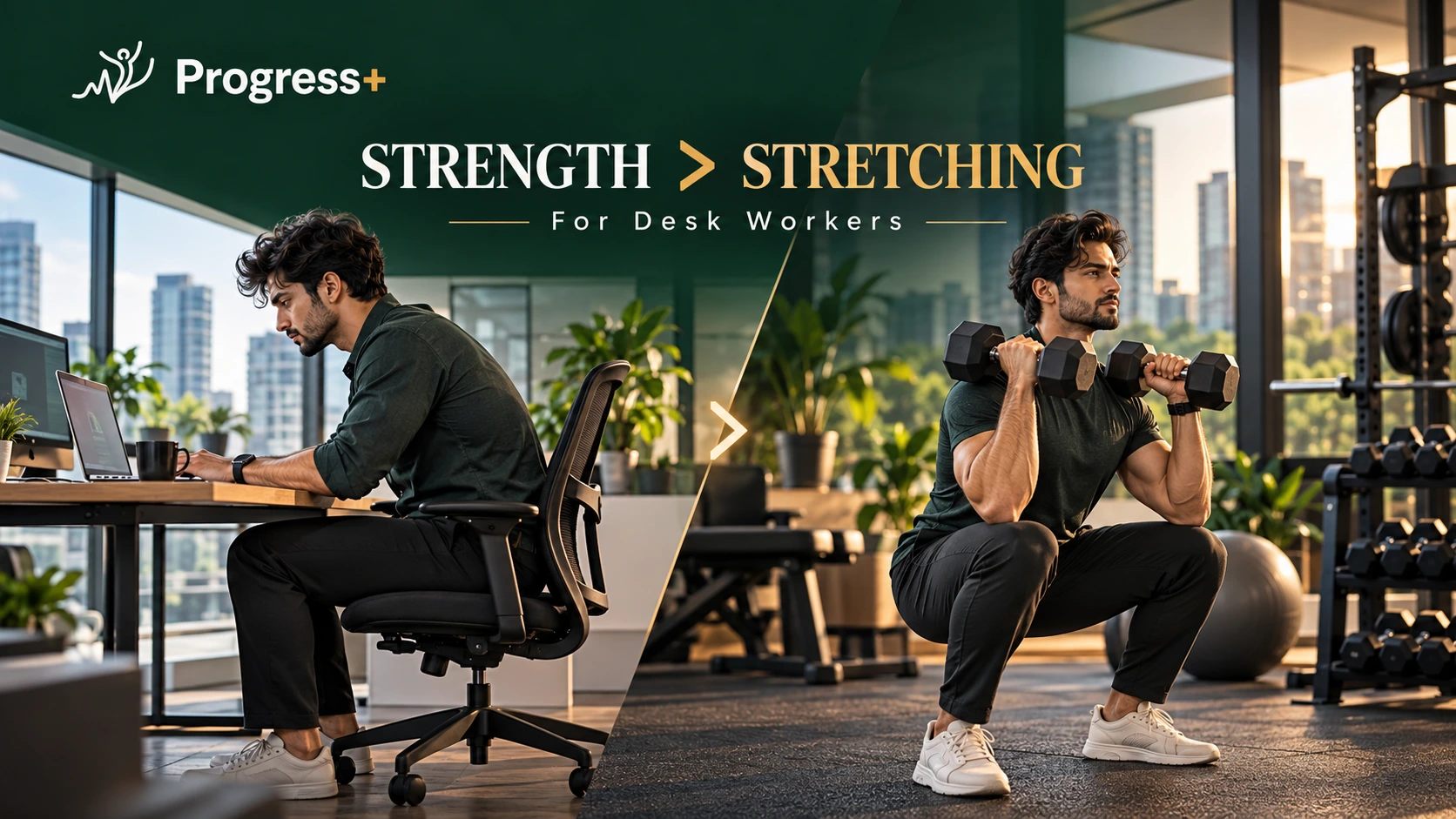
Strength training challenges your muscles to rebuild stronger, and it teaches your body to move well under load. Stretching alone rarely gives long term relief. Add strength training and the benefits last. That's why stretching versus strengthening isn't a close contest for most desk workers. Stretching is a helpful extra. Strength is the base.
Here's what the research and guidelines say.
- The guidelines: Canada's 24 Hour Movement Guidelines call for muscle strengthening on major muscle groups at least twice a week, along with 150 minutes of moderate to vigorous activity.
- The heart link: The University of Calgary cites a 2019 study that found resistance training lowered the risk of cardiovascular disease by 17 percent.
- Strength breaks: A University of Salford researcher built a three minute strength break for desk workers. It uses one set each of sumo squats, deadlifts, lunges, shoulder presses, bent over rows and overhead triceps presses, four times a day. Her simpler option is a minute of squats once an hour.
- The know how gap: A clinical exercise physiologist who studies this found that people aged 40 to 60 understood the value of strength training but didn't know how to start.
Now the honest part. A big Lancet review followed more than one million people. It found that about 60 to 75 minutes a day of moderate activity seemed to cancel the extra risk of death linked to high sitting time. Many blogs quote this as proof that lifting fixes everything. It doesn't say that. The study covers moderate activity in general, like brisk walking, and it's observational. Strength training is a strong foundation, but the best plan also includes walking, movement breaks, mobility work and a sensible desk setup.
Short strength breaks may also help blood flow, concentration and the mid afternoon slump. Results vary from person to person.
Desk exercises versus real strength training
You've seen the lists: seated leg raises, desk push ups, chair squats. They're useful. They get you out of your seat, boost blood flow and give your brain a break.
They can't replace real strength training. Muscles get stronger when you ask them to handle more over time. A chair squat done the same way for six months won't do that. Real progress needs functional compound movements under load, such as goblet squats, Romanian deadlifts, rows and loaded carries, plus a plan to make them gradually harder.
Think of two tools with two jobs:
- Movement snacks keep you from sitting too long.
- Strength sessions build the muscle that holds you upright.
A standing desk or a posture corrector can help a little. Neither builds muscle. Use them as helpers, not as the fix.
How much strength training do desk workers need?
Most desk workers do well with 2 to 3 sessions a week. Each can run 30 to 50 minutes. Two sessions every week for six months beat five sessions for two weeks and then a long break.
Pick the time you'll actually keep.
- Before work: Meetings can't steal it. Dark winter mornings are hard, so keep it short.
- Lunch hour: It breaks up your sitting and can ease the afternoon slump. You need a gym or home setup close by.
- After work: It helps you decompress. Plans and fatigue get in the way, so book it like a meeting.
On work from home days, a 30 minute session with dumbbells and a band is plenty. On office days, a lunch hour session or a stop on the way home works well.
The 8 week strength plan for Markham tech professionals
This plan suits beginners. Each session uses six movement patterns: hinge, squat, row, press, carry and core stability. Each phase asks a little more of you, which is how progressive overload works.
Rules for every session
- Warm up for 5 minutes with easy marching, shoulder rolls and a few hip hinges.
- Rest 60 to 90 seconds between sets.
- Stop each set with 2 or 3 good reps still in the tank.
- Add weight only when every set feels smooth for two sessions in a row.
- Stop and get advice if you feel sharp pain, numbness or dizziness.
Weeks 1 and 2: Foundation
Two sessions a week, about 25 to 30 minutes each.
| Exercise | Sets and reps |
|---|---|
| Glute bridges | 2 sets of 10 |
| Bodyweight squats to a chair | 2 sets of 10 |
| Dumbbell rows, light | 2 sets of 10 each side |
| Incline push ups on a desk or counter | 2 sets of 8 |
| Dead bugs | 2 sets of 6 each side |
| Bird dogs | 2 sets of 6 each side |
Goal: learn the moves and feel your glutes and upper back work.
Weeks 3 to 5: Add load
Two sessions a week, with an optional short third. About 35 to 40 minutes each.
| Exercise | Sets and reps |
|---|---|
| Goblet squats | 3 sets of 8 |
| Romanian deadlifts | 3 sets of 8 |
| Rows with a dumbbell or TRX | 3 sets of 10 |
| Overhead press | 2 to 3 sets of 8 |
| Farmer carries | 3 rounds of 30 seconds |
| Dead bugs | 2 sets of 8 each side |
Goal: train the hinge and squat under load and strengthen your upper back.
Weeks 6 to 8: Build
Two to three sessions a week, about 40 to 50 minutes each.
| Exercise | Sets and reps |
|---|---|
| Loaded squats (goblet, or barbell with a coach) | 3 sets of 6 to 8 |
| Single leg work, such as split squats | 3 sets of 8 each side |
| Rows and pull ups (use an assisted pull up if needed) | 3 sets of 6 to 10 |
| Overhead press | 3 sets of 6 to 8 |
| Face pulls | 3 sets of 12 |
| Suitcase carries | 3 rounds of 30 seconds each side |
| Pallof presses | 3 sets of 10 each side |
Goal: build strength, balance and stability in your hips and shoulders.
Form cues for the key moves
| Move | What to focus on |
|---|---|
| Glute bridge | Press through your heels and squeeze your glutes at the top for one second |
| Romanian deadlift | Soft knees, push your hips back, keep your back flat and stand tall |
| Goblet squat | Hold the weight at your chest, keep your elbows down and sit between your hips |
| Row | Lean slightly forward, pull your elbow toward your hip and squeeze your shoulder blade |
| Farmer carry | Stand tall, keep your ribs stacked over your hips and take short steps |
| Dead bug | Lower the opposite arm and leg slowly while your lower back stays calm |
| Bird dog | Reach long, keep your hips level and avoid arching your back |
| Face pull | Pull a band toward your face with your elbows high |
A sample week
| Day | Focus | Time |
|---|---|---|
| Monday | Full body strength | 40 minutes |
| Tuesday | Walk and movement snacks | 10 to 20 minutes |
| Wednesday | Rest or mobility | 10 minutes |
| Thursday | Full body strength | 40 minutes |
| Friday | Movement snacks and a light walk | 10 to 20 minutes |
| Saturday | Optional third session | 30 minutes |
| Sunday | Rest | None |
How to track progress
Keep a simple log. Write down the weight, your reps and your 1 to 10 stiffness score at 3 pm. Strength numbers should climb. Stiffness often drops within a few weeks. If a number stalls, repeat the same weight for another session before you move up. In week 8, repeat the two minute desk check and compare.
Later progressions
Once the plan feels easy, you can try moves like a half kneeling landmine press or a half Turkish get up. Learn those with a coach, because they demand more control.
Movement snacks and mobility between meetings
A movement snack is a short burst of activity that breaks up sitting. Use a call, a coffee or a calendar reminder as your cue.
A three minute strength break you can adapt
- Do 10 chair squats.
- Do 10 hip hinges with a flat back.
- Do 8 band rows if you keep a band at your desk.
- March in place for 30 seconds.
Three quick mobility drills
- Thoracic extension: Sit tall with your hands behind your head. Gently arch over the top of your chair back and breathe out. Do 5 slow reps.
- Hip flexor stretch: Kneel on one knee, squeeze the back glute and shift forward until the front of the hip opens. Hold 30 seconds each side. This also helps hip extension.
- Ankle rocks: In a lunge stance, slide your knee over your toes while your heel stays down. Do 10 each side.
A meeting day menu
| Time | Move |
|---|---|
| Before your first call | 10 minutes of hinges and bridges, or a short walk |
| Mid morning | One 3 minute strength break |
| Lunch | A 10 minute walk, or your lunch hour session |
| Mid afternoon | Thoracic extension and a hip flexor stretch |
| Evening | Your planned strength session, or rest |
Fit strength training into the Markham week
Real life breaks most plans, so build around it.
- Commute days: Markham has four GO stations on the Stouffville line, and a commuter guide says trips to downtown Toronto can take as little as 41 minutes. Check the current GO schedule for exact times. Stand on the platform, walk to the station and save your lifting for before or after work.
- Work from home days: Keep a band and dumbbells where you can see them. A 3 minute break between calls beats a plan you never start.
- Back to back meetings: Block 30 minutes on your calendar like a client call and treat it as unmovable.
- Winter and dark mornings: Shorten the session and train at home when roads are rough.
- Gym options: A basic condo gym with dumbbells covers this plan. A coached gym helps if you want feedback on form.
Equipment, ergonomics and setup
You can start with almost nothing, then upgrade as you go.
- Bodyweight only: Glute bridges, chair squats, dead bugs, bird dogs and incline push ups.
- Bands: Add rows, face pulls and Pallof presses.
- Dumbbells or a kettlebell: Add goblet squats, Romanian deadlifts, rows and presses.
- TRX or a full gym: Add rows and pull ups, plus barbell options.
Small desk changes help too. Keep the top of your screen near eye level, keep your feet flat on the floor and use a laptop stand with a separate keyboard if you work on a laptop. These tweaks don't replace training, but they slow down the strain.
Safety first: screening and when to get help

Anyone who is new to exercise or has been inactive should screen first. The PAR-Q+ is a standard tool that flags who may need medical clearance before becoming more active. CSEP also offers the Get Active Questionnaire, which helps you decide whether you can start on your own or should talk to a healthcare provider first.
Stop and seek advice if you notice:
- Chest pain or pressure
- Dizziness or unusual shortness of breath
- Numbness, tingling or pain that travels down an arm or leg
- Pain that gets worse or doesn't settle after a few days
In Ontario, the title kinesiologist is protected. Only people registered with the College of Kinesiologists of Ontario can use it, and the College keeps a public search so you can check someone's registration. A Registered Kinesiologist can assess how you move and build a program around your needs. OHIP doesn't cover kinesiology, but some extended health plans do, so check with your insurer. For a diagnosis or a new injury, start with your doctor.
Common mistakes tech workers make
- Skipping hinges and rows. They target the exact areas sitting weakens.
- Stretching without strengthening. Relief fades when weak muscles stay weak.
- Lifting too heavy too soon. Good form beats big numbers in the first 8 weeks.
- Training once, then stopping. Consistency beats intensity.
- Ignoring recovery. Sleep, food and rest days help your muscles adapt.
- Sitting still after a good workout. One session doesn't cancel a long sitting day, so keep moving in small bursts.
Where to start in Markham
If you want help, start with a short assessment. A coach or Registered Kinesiologist can check how you move, spot weak links and build a custom strength and mobility program around your schedule. Many people like small group or in home sessions because the workout is already planned and someone watches their form.
Progress+ offers personal training and kinesiology support across Markham. Book Your Free Assessment
Frequently asked questions
How often should desk workers strength train?
Does strength training help low back pain from sitting?
Is strength training better than stretching for desk workers?
What strength exercises fix rounded shoulders and forward head posture?
How long before I notice a difference?
Can I do this at home without a gym?
Do I need medical clearance before starting?
How do I train around hybrid work and a long commute?
Conclusion
Desk work weakens your glutes, upper back and core, and it tightens your hips. Strength training two or three times a week is the strongest foundation for turning that around, and short movement breaks keep the progress going between sessions.
Your first step is small. Do ten glute bridges today, then follow the 8 week plan one week at a time. You do not need a perfect schedule. You need a plan you can keep through a Markham winter, a long commute and a heavy meeting week.
If you would like a Registered Kinesiologist supervised plan built around your body and calendar, Begin Your Program and book your free assessment. We will meet you where you are and help you build from there.