Summary
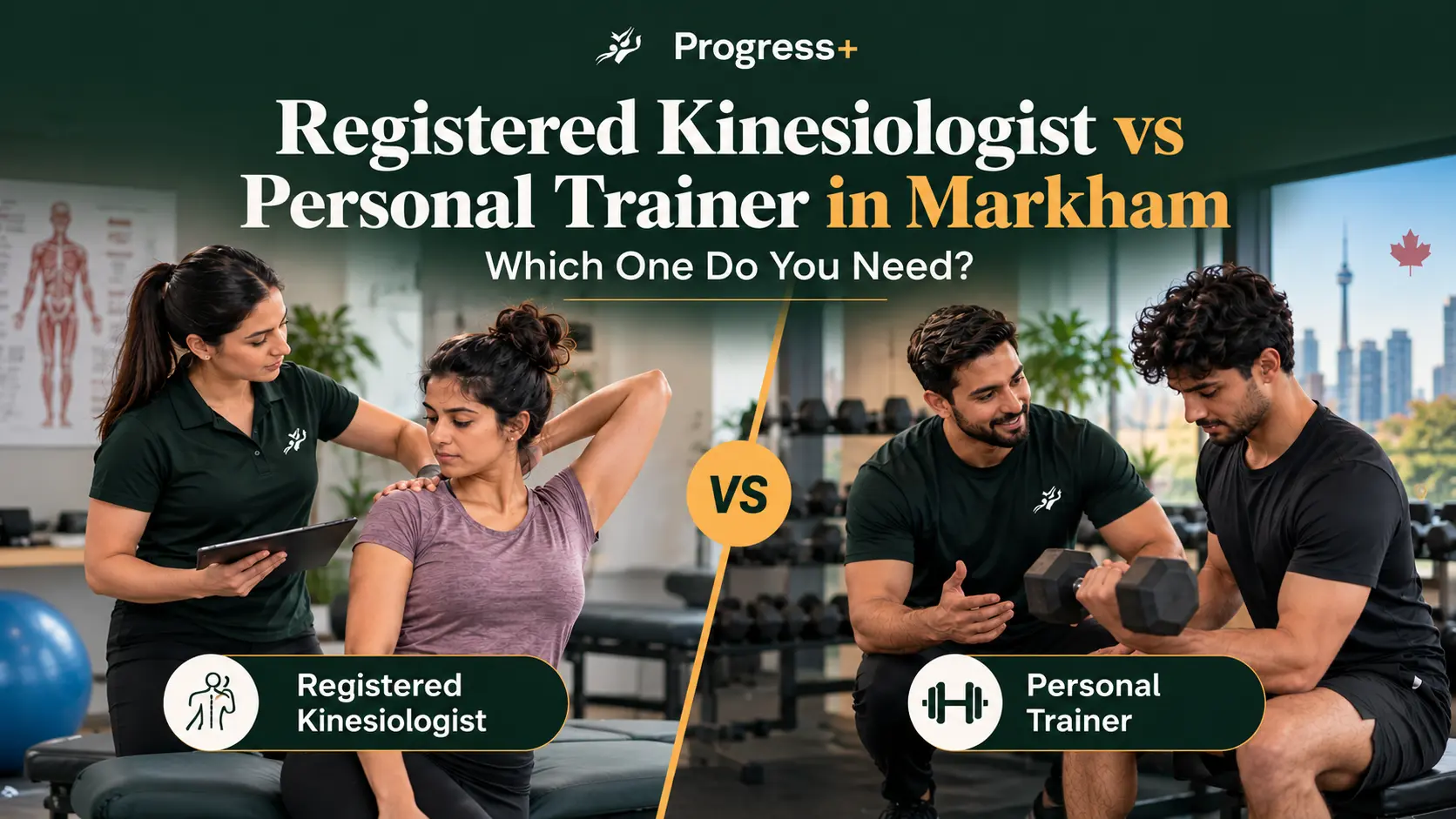
Kinesiologist or personal trainer? In Ontario, the two jobs overlap, but they are not equal. A Registered Kinesiologist is a regulated health professional with a four year degree and a College exam behind the title. Personal training is an unregulated field, so quality depends on the certification and the person. This guide compares regulation, education, scope of practice, and work setting, then helps you choose based on your health and your goals. You will also learn how to check credentials, which insurance and tax rules may apply, and what training at home in Markham looks like.
Key takeaways
- The titles carry different weight. "Registered Kinesiologist" and "R.Kin" are protected in Ontario, and the College of Kinesiologists of Ontario oversees the profession. Personal training is an unregulated field in Ontario.
- Kinesiologists study human movement in depth. They spend at least four years on biomechanics, anatomy, and physiology, then pass the COKO exam before they register.
- Trainers vary a lot. A CSEP-CPT needs at least two years of related post secondary study, while other certifications ask for far less. Judge the person, not just the title.
- Pick a kinesiologist for a medical condition, an injury, a disability, or mobility issues. The same goes if you are coming out of physiotherapy and want a careful path back.
- A trainer can be enough for a healthy adult. Weight loss, muscle gain, and general conditioning are all fair reasons to hire a good one.
- You can check anyone in minutes. The College's public register lets you search by name, city of practice, language of care, or registration number. Ask for the registration number on your invoice too.
- Do your homework on money. OHIP does not cover kinesiology, though some extended health plans do. A tax credit may apply when services relate to an existing condition, and you need receipts. The federal credit rate is currently 14%. Ask your accountant about your own situation.
- Home visits change what a professional can see. A mobile trainer or an in home kinesiologist in Markham can look at your stairs, floors, and living space.
- Your first step can be free. A complimentary assessment lets you ask questions and decide with no pressure.
Introduction
Picture this. You live in Unionville, Cornell, or Berczy Village, and you finally decide to get help with your fitness. Or you want a safer routine for a parent who struggles on the stairs. You search online and find two titles that sound almost the same, kinesiologist and personal trainer.
They are not the same job. The right pick depends on your health, your goals, and how much professional oversight you want. This guide explains the key differences in plain words, shows who fits where, and gives you a five minute way to check anyone before you book.
The short answer
Pick a Registered Kinesiologist if you have a medical condition, an injury, a disability, or mobility issues. Their fees may also count toward insurance or tax claims. A qualified personal trainer can be enough if you are healthy and want weight loss, muscle gain, or general conditioning. In Ontario, only the kinesiologist is a regulated health professional. Whoever you choose, verify their credentials first.
Key differences between a kinesiologist and a personal trainer
| Registered Kinesiologist | Personal trainer | |
|---|---|---|
| Title | Protected by law in Ontario. | Not protected. |
| Oversight | College of Kinesiologists of Ontario. | No government regulator. |
| Training | Four year kinesiology degree or similar, plus the College's exam. | A private certification, from a short course to a program that needs two years of study first. |
| Works with | Healthy people, and people with medical conditions, injuries, or disabilities. | Mostly healthy adults, and stable conditions for some certifications. |
| If something goes wrong | Public complaints process. | Employer or certifying body. |
| Coverage | Some extended health plans pay, and fees may qualify as a medical expense. | Usually not covered. |
Both jobs involve human movement, but they sit in different places. Here is how the two compare in detail.
Regulation
Only people registered with the College of Kinesiologists of Ontario can practise kinesiology or use the titles "kinesiologist," "Registered Kinesiologist," and "R.Kin." The Kinesiology Act, 2007 protects those titles. Personal training works differently. Personal training is not a regulated field in Ontario, and trainer qualifications vary a lot.
That makes Ontario unusual. Outside Ontario, neither profession is regulated in the same way, so advice you read from other provinces may not apply here.
Education
To register, a kinesiologist needs a degree in kinesiology that runs at least four years, or a similar degree such as human kinetics or physical education. They also need a criminal record check and a pass on the College's entry to practice exam. Then they renew every year.
Trainers take another path. They earn a personal trainer certification from a private body, such as canfitpro (PTS), CPTN-CPT, CSEP-CPT, NASM, or ISSA. Several of these ask only for a minimum age, first aid and CPR, and sometimes a high school diploma. CSEP is the exception, since it wants at least two years of related study. Many trainers also keep learning through personal trainer workshops and courses.
Scope of practice
A kinesiologist works with special populations and with complex injuries and underlying health conditions. Their toolkit includes exercise prescription, postural assessment, ergonomics, and exercise therapy.
A trainer designs client tailored exercise programs. The job runs from assessment to design, implementation, and monitoring. It suits fitness goals well.
Here is the part many websites skip. The line between the two is not as sharp as they claim. A CSEP certified trainer works with apparently healthy people or people with a stable condition who can exercise on their own. So a trainer can sometimes work with you after your doctor clears you. The real difference is depth, how far the professional can go when your situation gets complicated.
Work setting
Kinesiologists work in many places. The College lists hospitals, family health teams, rehabilitation and wellness clinics, long term care homes, health and fitness clubs, and private practice. You may meet one at a physio clinic or a gym.
Trainers usually work at a gym or fitness studio. Some are mobile trainers who make home visits.
What is a kinesiologist?
Kinesiology is the scientific study of human movement, performance and function. It draws on biomechanics, anatomy, and physiology, and it also considers how the nervous system and daily life affect the way you move. A kinesiologist is a health professional who works with that science every day.
What does a kinesiologist do?
Think of it as detective work with exercise as the fix. Here is what a first visit usually looks like.
- Listening. You can expect a full health history and a talk about your goals.
- A thorough assessment. Common checks include strength and flexibility tests, cardiovascular testing, and gait assessment. Your kinesiologist also looks at posture, muscle imbalances, previous injuries, and any faulty exercise technique that keeps causing trouble.
- A detailed exercise plan. This is a safe exercise plan built around your findings, not a copy of what worked for someone else.
- Progress monitoring. They measure how you improve and adjust the plan, which also keeps you accountable.
A big part of the job is correcting human movement through exercise. That means finding the habit or imbalance behind the problem and fixing it step by step. It supports injury prevention, injury rehab, and health coaching. The goal is a body that moves in a functional, resilient way.
Your doctor still diagnoses medical conditions. A kinesiologist uses exercise to support your health and works alongside your medical team.
How does someone become an R.Kin?
They finish the degree, pass the COKO exam, and pass the criminal record check. Then they register and renew each year. The College also runs quality assurance and continuing professional development programs. That ongoing oversight is a big reason people trust the R.Kin title.
What is a personal trainer?
A personal trainer helps you reach fitness goals like weight loss, muscle gain, and general conditioning. Many people also come for fitness and body aesthetics goals. A good trainer teaches you correct exercise technique, keeps you motivated, and holds you accountable when your energy dips.
Trainers vary a lot. A trainer with two years of study behind a CSEP-CPT is not the same as a trainer who finished a short course. Neither is automatically better or worse for every person. Ask about the certification, how current it is, and what training came before it. Ask what the trainer does when a client mentions a health problem. The answer tells you a lot.
Which is better, a kinesiologist or a personal trainer?
Neither wins for everyone. The better choice is the one that matches your health and your goals.
Why would you see a kinesiologist?
Ask yourself, why should I see a kinesiologist instead of a trainer? These are the strongest reasons. You live with a medical condition, an injury, or a disability. You have mobility issues, or moving feels harder than it used to. Your case involves complex injuries or underlying health conditions. You are recovering after physiotherapy and want a careful bridge back to normal training. You want a professional who can coordinate with your doctor or physiotherapist. You hope to use extended health benefits, or you may claim your fees as a medical expense later.
When is a personal trainer enough?
If you feel healthy, have no injuries, and want fitness, weight loss, or muscle gain, a strong personal trainer can serve you well. Some people even use both, a kinesiologist to set up a safe base, then a trainer for long term training. If you are unsure, tell any trainer about your health up front and check with your doctor.
Five common Markham situations
These are examples, not real clients.
| Situation | Best fit |
|---|---|
| Healthy professional in Cornell who wants muscle gain and a stronger back. | Either one. Ask for a proper assessment. |
| Parent in Unionville with prediabetes and high blood pressure. | Registered Kinesiologist, with your doctor's approval. |
| New mother in Berczy Village who wants to return to training. | Registered Kinesiologist, working with your pelvic floor physiotherapist or OB/GYN. |
| Adult child arranging exercise for a parent with mobility issues. | Registered Kinesiologist. |
| Someone who just finished physiotherapy for a knee injury. | Registered Kinesiologist first, then either one. |
Nothing in this guide replaces medical advice. Talk to your doctor before you start any new exercise program, especially if you live with a health condition.
Can a kinesiologist also be a personal trainer?
Yes. Many Registered Kinesiologists also hold a personal trainer certification. The reverse does not work. A trainer cannot use the kinesiologist title unless they are registered with the College. If you want both skills, ask which credentials someone holds and check the ones that matter.
Who does what, kinesiologist, physiotherapist, or sports medicine doctor?
They work as a team. A sports medicine doctor helps figure out what is going on. A physiotherapist often treats an injury at a physio clinic. A kinesiologist then builds your strength and movement plan and keeps you progressing. Many people move from one to the next as they recover.
How to check a kinesiologist or personal trainer in five minutes
Anyone can say they are qualified. Here is how you confirm it.
- Search the public register. The College's Find a Kinesiologist tool lets you search by first or last name, city of practice, language of care, or registration number. The language filter helps Markham families who want care in a language other than English.
- Read the title carefully. Only registrants may use "kinesiologist," "Registered Kinesiologist," or "R.Kin." Labels like "R.Kin candidate" or "Pending R.Kin" from anyone who is not registered count as misuse of the title.
- Ask for the registration number on your invoice. Registered kinesiologists should provide their registration number on invoices. Your insurer or accountant may ask for it.
- Question any trainer. Ask which body certified them, whether it is current, whether they carry insurance, and how they handle clients with health conditions.
- Know where problems go. For a kinesiologist, you can use the College's concerns and complaints process. For a trainer, you usually go to the employer or the certifying body.
Walk away if someone promises a cure, skips the assessment, ignores your doctor's advice, or cannot show a registration number when they claim to be a kinesiologist.
Insurance and tax, what to know before you book
Money is often the deciding factor, so here is the fuller picture.
Insurance. OHIP does not cover kinesiology services. Some extended health plans cover kinesiology services within its scope of practice. Look in your benefits booklet for a paramedical line that says "kinesiology" or "R.Kin." Call your insurer and ask about yearly limits, receipt rules, and whether they cover home visits. A health spending account may also help. These accounts can pay for expenses that also qualify for the Medical Expense Tax Credit.
Tax. Ontario recognized kinesiologists as authorized medical practitioners for tax purposes in January 2014. Here is the detail many websites leave out, the CRA treats payments to medical practitioners as eligible when they cover medical services that relate to an existing illness or condition. General fitness goals may not meet that test. You also need proper receipts. You can only claim costs your insurer did not pay back.
The credit rate changed too. The federal credit rate is currently 14%, and a top up credit effectively keeps the 15% rate for credit amounts above the first bracket threshold of $58,523. Ontario adds its own credit on top. Here is a simple example, if $1,000 of eligible costs sit above your threshold, the 14% federal credit is worth $140 in federal tax. The threshold depends on your income and changes each year, so check the CRA site for this year's figure.
These are general facts, not tax advice. Speak with your accountant to confirm eligibility for your situation. For a deeper walk through the tax form, read Claiming Your Mississauga Kinesiologist Sessions on Your Canadian Tax Return. The Ontario rules are the same in Markham.
What does each cost in Markham?
Prices vary, and so do the services behind them. Private personal training in most of the GTA often runs around $70 to $120 per hour. One Toronto provider that lists in home rates publicly charges $85 and $105 for trainers and $120 and $150 for kinesiologists per 60 minute session, before 13% tax. That is one provider's price list, not a market average.
When you compare, look past the hourly rate. Does the price include a full assessment and a written plan? Will you get progress reports? Does the provider travel to your home at no extra charge? Could part of the cost come back through insurance or a tax credit?
Training at home in Markham
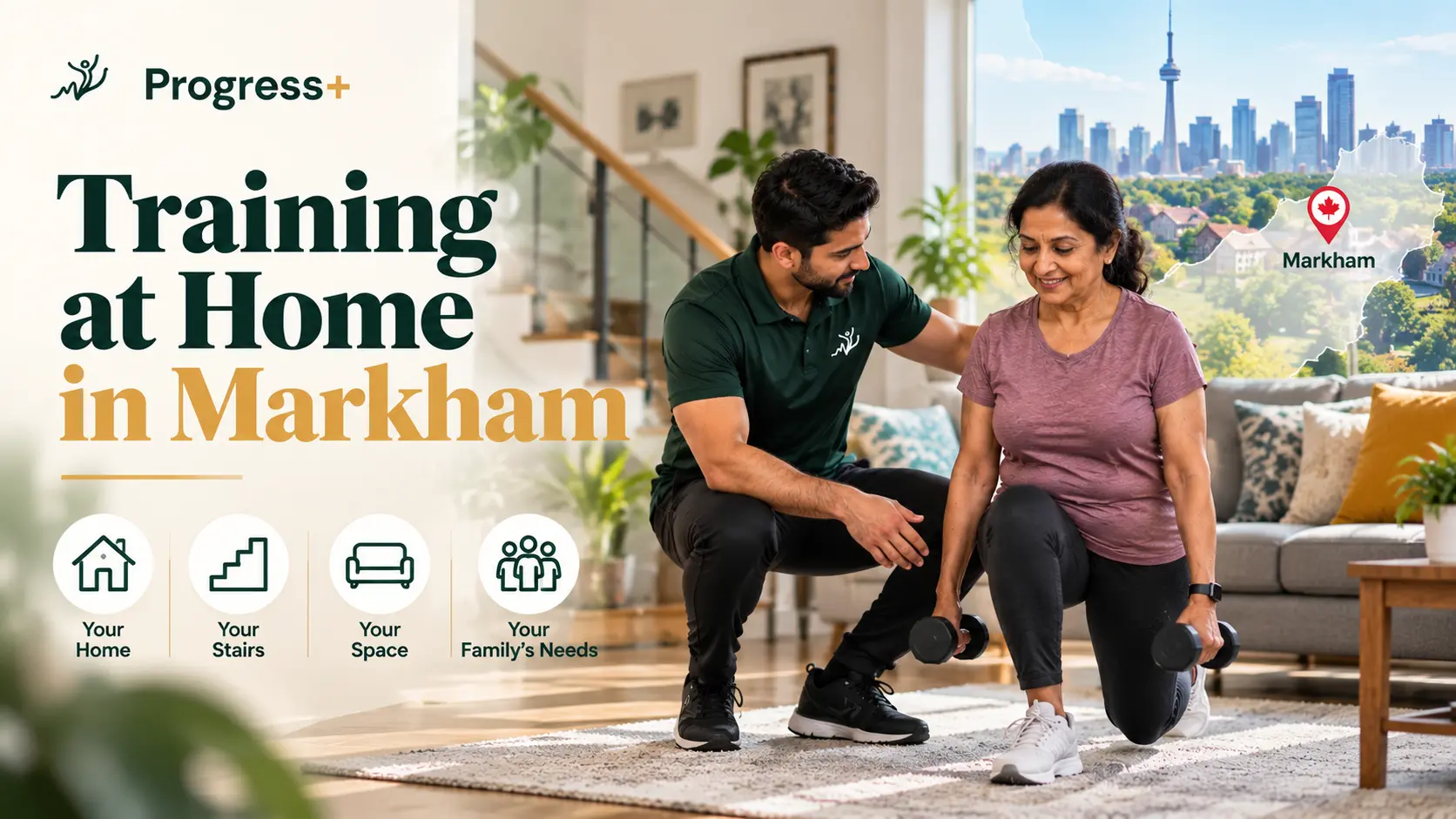
A mobile trainer or an in home kinesiologist in Markham can save you the drive, and they can also see how you really move. Your stairs, your floors, and your living room space all matter for safety, and a gym never shows them.
Markham is one of the most diverse cities in Canada. The 2021 Census shows Chinese residents make up about 47.9% of the city and South Asian residents about 17.6%. Many households have parents, adult children, and grandparents living together, and each person may need something different. Some families also prefer care in Cantonese, Mandarin, Punjabi, or Hindi. That is why the register's language filter is worth using.
How Progress+ works in Markham
Progress+ starts with a complimentary assessment with a Registered Kinesiologist at your home, your building's gym, or your clinic. Think of it as a free consultation with no commitment. You talk through your history and goals, and you leave knowing what a safe first step looks like. See our In-Home Personal Trainer in Markham page for details, or read What is a Registered Kinesiologist and Why Does It Matter for Your Workout? for the basics.
Frequently asked questions
Can a personal trainer work with someone who has an injury?
Do I need a referral to see a kinesiologist?
Does OHIP cover a kinesiologist?
Can I claim kinesiology on my taxes in Ontario?
How do I know someone is a real Registered Kinesiologist?
Are kinesiology and personal training both regulated in Ontario?
What is the difference between a kinesiologist and a physiotherapist?
Can a kinesiologist help me with weight loss or muscle gain?
Conclusion
Let's be honest, picking between a kinesiologist and a personal trainer feels like a big decision because it is about your body. Take a breath. You don't have to get it perfect on day one. You just need to ask good questions.
If your health has a story, such as a medical condition, an injury, or mobility issues, a Registered Kinesiologist brings deeper training and a public register you can check. If you feel healthy and want general conditioning, weight loss, or muscle gain, a well qualified trainer can do a great job. Plenty of people start with one and add the other later. That is completely normal.
Whoever you choose, keep three habits. First, look them up on the College's register or with their certifying body. Second, ask your insurer what your extended health plan covers. Third, keep every receipt. Then pay attention to how they treat you. A good professional listens first, explains the plan in plain words, and never gets annoyed by your questions. If someone brushes you off, keep looking.
Many Markham families plan for more than one person, maybe you, your partner, and a parent or grandparent. A home visit makes that easier because your assessment happens where you actually live and move. Over time, the goal is simple, a body that feels functional, resilient, and ready for daily life.
Ready to talk it through? Book a free assessment with a Registered Kinesiologist, and bring your questions. You can also read more about our In-Home Personal Trainer in Markham service first. Please check with your doctor before you start something new, especially if you live with a health condition.