If you are paying for kinesiology sessions in Mississauga, there is a real chance you can claim part of that cost back on your Canadian tax return. Registered Kinesiologists in Ontario are recognized by the CRA as authorized medical practitioners, which means their sessions can count toward the Medical Expense Tax Credit, once your total eligible expenses pass a set threshold for the year.
Here is the short version. For 2026, you can claim the amount you spend above the lesser of 3 percent of your net income or 2,890 dollars. The federal credit rate is currently 14 percent, following a rate change under Bill C-4 in mid 2025. If your kinesiologist is registered with the College of Kinesiologists of Ontario, your sessions may already be covered in part by insurance or a Health Spending Account, and whatever is left over out of pocket can often be claimed too.
This guide walks through exactly how that works, what line to use on your return, how to confirm your kinesiologist is properly registered, a few lesser known rules that can genuinely increase what you get back, and the mistakes that get claims rejected. Everything here is based on current CRA guidance, though your own numbers will depend on your income and situation, so it is always smart to double check the specifics with an accountant before you file.
Key Takeaways
Kinesiology sessions from a Registered Kinesiologist in Ontario can qualify for the CRA Medical Expense Tax Credit, because kinesiologists are a regulated health profession in the province.
This only applies to registered practitioners. Always check for a registration number on your invoice, and confirm it against the College of Kinesiologists of Ontario's public register before assuming your sessions qualify.
For 2026, you can claim the amount you spend above the lesser of 3 percent of your net income or 2,890 dollars. Whichever number is smaller becomes your actual threshold.
The federal credit rate is now 14 percent, down from 15 percent after a change under Bill C-4 in mid 2025. If you have seen older articles quoting 15 percent, that information is outdated.
Use line 33099 to claim expenses for yourself, your spouse or common law partner, and children under 18. Use line 33199 if you are covering costs for a parent or other dependant who relies on you for support.
You do not have to use the calendar year for your claim. Any 12 month period ending in the tax year works, which gives you flexibility if your expenses came in bursts across two years.
Insurance and the tax credit are not competing options. If your extended health plan or Health Spending Account covers part of your sessions, you can still claim whatever you paid out of pocket on top of that.
If you are supporting a parent's in-home training, their sessions may be claimable under line 33199, using their income, not yours, to work out the threshold.
General fitness training does not qualify, even if it looks similar to kinesiology. The service has to come from someone who is actually Registered with the College, not just experienced or certified elsewhere.
Keep every invoice with the registration number and HST number, and hold onto them for at least six years. Good documentation is what protects your claim if the CRA ever asks questions.
Introduction
If you are paying out of pocket for kinesiology sessions in Mississauga, there is a good chance you are leaving money on the table. Most people have no idea that a Registered Kinesiologist's services can count as a medical expense on their tax return. Even fewer know how much that actually adds up to, or how to combine it with insurance to save even more.
This guide breaks it down in plain language. No jargon, no guesswork, just what the Canada Revenue Agency actually says, what it means for you in 2026, and a few things almost nobody explains clearly.
Is Kinesiology Tax Deductible in Canada
Quick answer, Yes, kinesiology sessions from a Registered Kinesiologist in Ontario can qualify for the CRA Medical Expense Tax Credit. You claim the portion your insurance does not cover, once your total medical expenses for the year pass a set threshold.
Now let us walk through exactly how that works.
Kinesiology became a CRA recognized medical expense because kinesiologists in Ontario are a regulated health profession under the Kinesiology Act, 2007. That single fact is the reason this works. The CRA does not treat every wellness service as a medical expense. It looks at whether the person providing the service is officially regulated, and in Ontario, kinesiologists are.
This is important to say clearly. This rule currently applies in Ontario because that is the only province where kinesiology is a regulated profession. If you live somewhere else in Canada, this may not apply to you the same way.
Why Ontario Kinesiologists Qualify as Authorized Medical Practitioners
The College of Kinesiologists of Ontario, often shortened to CoKO, is the regulatory body that oversees kinesiologists across the province. Once someone passes the entry to practice exam and registers with the College, they earn the title Registered Kinesiologist and the designation R.Kin.
Because of this regulation, the CRA lists kinesiologists on its official page of authorized medical practitioners for the purposes of claiming medical expenses. That listing is what makes your sessions eligible in the first place. Without that regulated status, none of this would apply.
How to Know Your Kinesiologist Is Actually Registered
This part matters more than people realize, and it is something most articles on this topic skip entirely.
Not everyone who calls themselves a kinesiologist is actually registered. The title is protected by law, but some unregulated practitioners still use it, and their services will not qualify for your tax claim.
Here is how to check in under a minute.
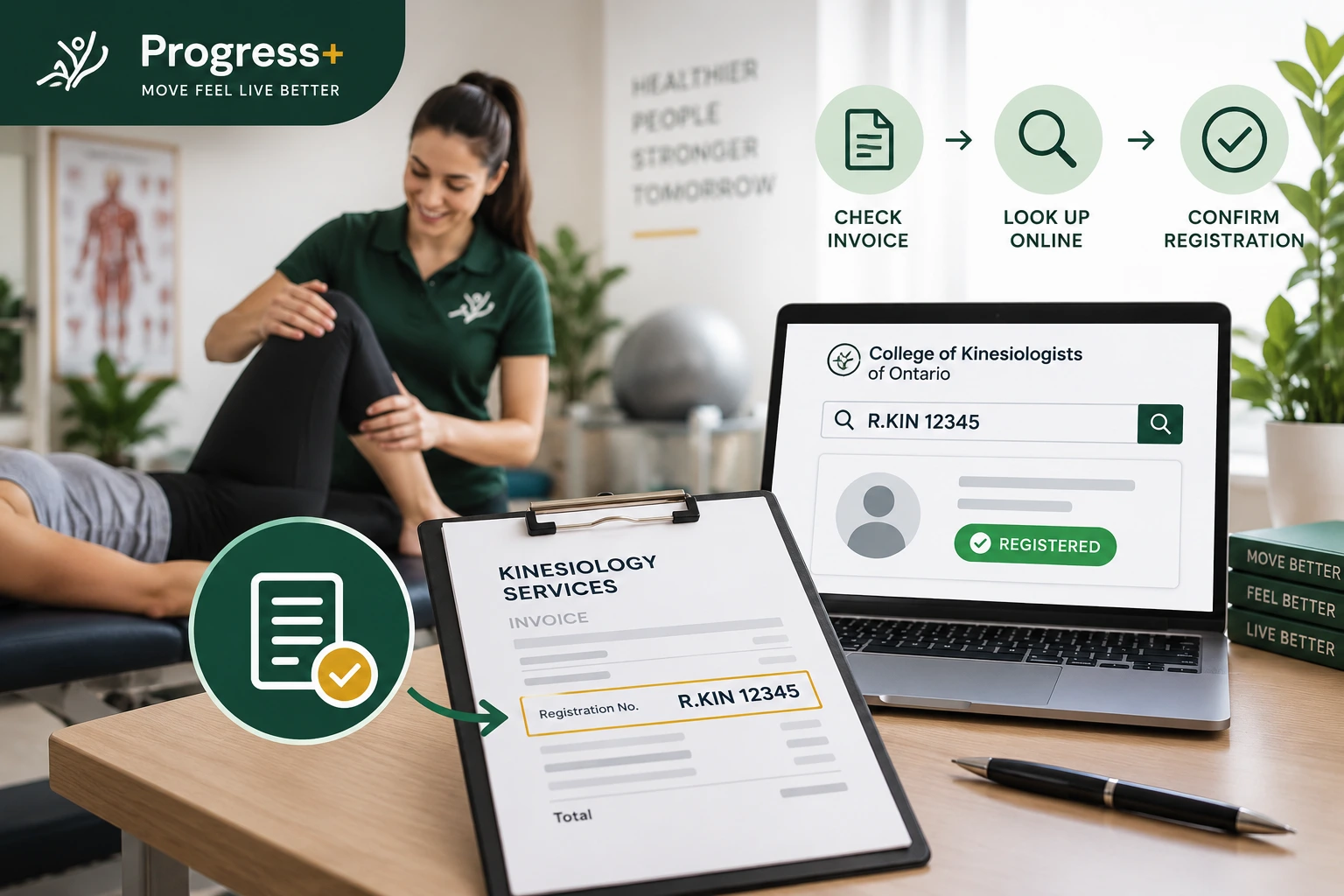
Look at your invoice. Every Registered Kinesiologist is required to include their registration number on it.
Search the College's public register online. You can look someone up by name or registration number and confirm they are actively registered.
If a kinesiologist cannot give you a registration number, treat that as a red flag, both for the quality of care and for your tax claim.
What You Can Actually Claim Line by Line
Once you know your sessions qualify, the next question is where they go on your return.
Line 33099 covers medical expenses for yourself, your spouse or common law partner, and any children under 18. This is where most people will enter their kinesiology sessions.
Line 33199 covers expenses for other dependants, such as a parent, grandparent, or adult child who depends on you for support. If you are paying for a parent's in-home sessions, this is the line you want.
Net income also plays a role here. Your net income is the number found on line 23600 of your return, and it directly affects how much of your claim you can actually use, which brings us to the next part.
How Much You Get Back in 2026
This is where most competing articles either go quiet or use outdated numbers. Here is the current picture.
For 2026, you can claim the amount of your eligible medical expenses that goes above the lesser of 3 percent of your net income or a fixed threshold of $2,890. Whichever number is smaller becomes your cutoff.
The federal credit rate also changed recently. Under Bill C-4, the federal rate dropped from 15 percent to 14 percent, effective July 1, 2025. Many older articles about kinesiology and taxes still quote the old rate, so this is worth double checking when you file.
Worked Example, Real Numbers
Say your net income is $70,000. Three percent of that is $2,100, which is lower than the fixed cap of $2,890, so your threshold is $2,100.
If you spent $3,000 on kinesiology sessions over the year, you would subtract the $2,100 threshold, leaving $900 eligible for the credit.
≈ $126 back federally
At the 14 percent federal rate, that works out to roughly $126 back federally, plus an additional provincial credit on top.
One detail that rarely gets mentioned is spousal strategy. If you have a spouse or common law partner, it is almost always better to claim the family's medical expenses on the lower income partner's return. A lower income means a lower 3 percent threshold, which means more of your expenses clear the bar and qualify for the credit.
The 12 Month Rule Most People Don't Know About
Here is a genuine loophole in your favor, and it is completely legitimate.
You are not required to use the calendar year for your claim. The CRA lets you choose any 12 month period that ends within the tax year. So if you had a cluster of sessions in late 2025 and another cluster in early 2026, you may be able to pick a 12 month window that captures both groups of expenses in a single, larger claim, as long as you have not already claimed them elsewhere.
This small piece of flexibility can make a real difference if your kinesiology expenses tend to come in bursts, such as after an injury or during a focused training block.
Stacking Insurance and the Tax Credit Together
This is the part almost no other content on this topic explains well, and it is genuinely useful.
Because kinesiology is a regulated health service in Ontario, many extended health benefit plans and Health Spending Accounts already include coverage for it. If your plan reimburses part of your sessions, you can still claim the leftover amount you paid out of pocket on your tax return.
In other words, insurance and the tax credit are not either or. They work together. Insurance covers its share, and the tax credit picks up part of what is left.
If you have no insurance coverage at all, you are not out of luck either. You simply claim the full eligible amount you paid, once it clears the threshold.
If you were reimbursed through your employer and that reimbursement was added to your income on a T4 slip, you can still claim the full expense, as long as you did not deduct that reimbursement anywhere else on your return.
Claiming Sessions for a Parent or Family Member
If you are helping cover the cost of in-home kinesiology sessions for an aging parent, this section is for you.
Line 33199 lets you claim medical expenses for a dependant such as a parent, grandparent, or adult child who relies on you for support. The threshold calculation here is based on the dependant's own net income, not yours. That distinction matters because it can lead to a larger claimable amount than you might expect.
This is one of the most overlooked parts of this entire topic. Adult children supporting a parent's mobility, balance, or fall prevention training often have no idea this option exists.
Documents You Need to Support Your Claim
Keeping the right paperwork now saves a headache later.
Save every invoice, and make sure each one shows the kinesiologist's registration number and, where applicable, an HST number. These details are what turn a vague claim into a fully supportable one if the CRA ever asks questions.
Hold onto your receipts for at least six years, since the CRA can request supporting documents well after you file.
If part of your cost was reimbursed and that reimbursement shows up as income on a T4 slip, keep that document too. It is what allows you to claim the full expense instead of just the unreimbursed portion.
Common Mistakes That Get Kinesiology Claims Rejected
A few small errors show up again and again.
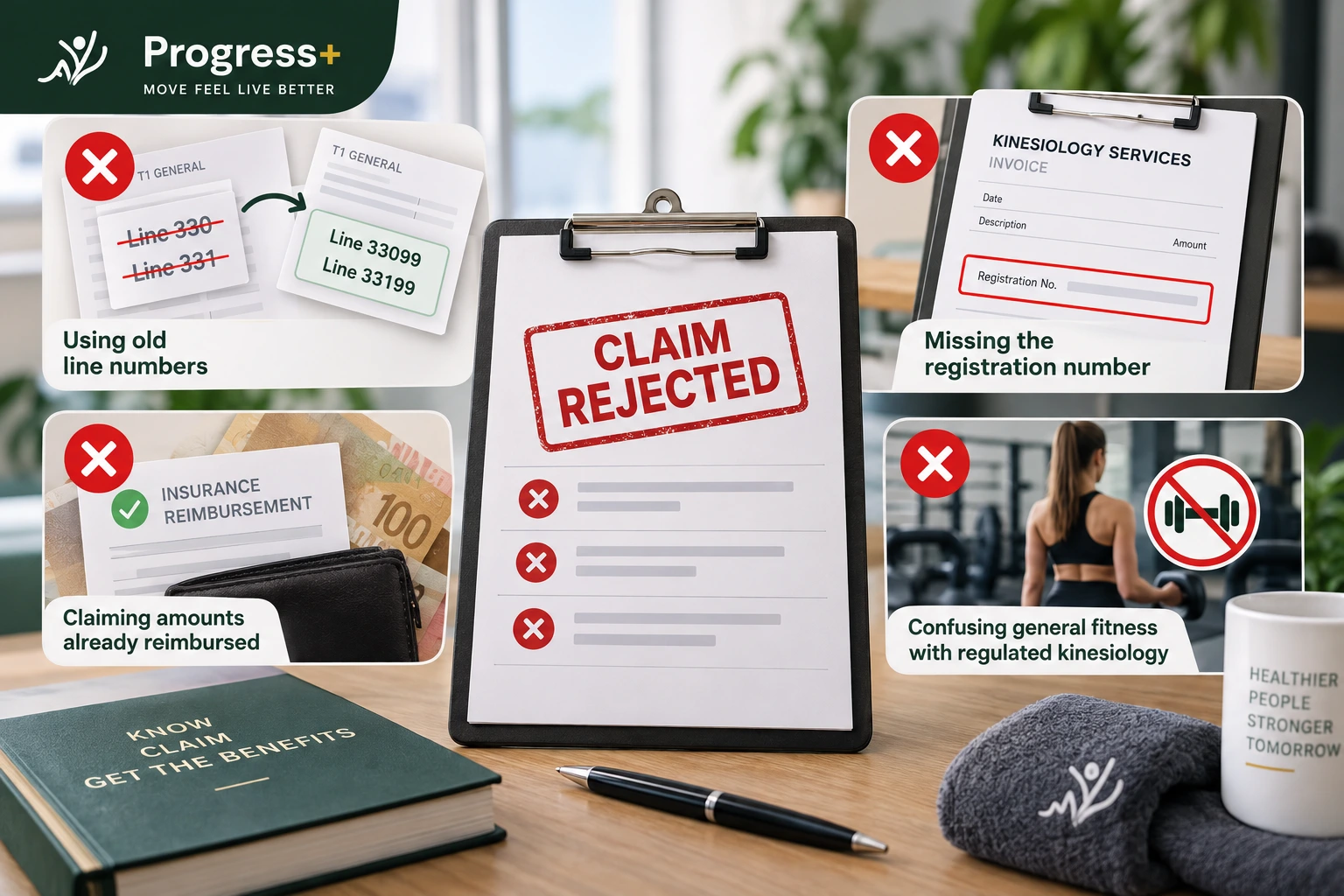
Using the old line numbers. Some guides online still reference line 330 or line 331. Those were replaced by line 33099 and 33199.
Missing the registration number. Without it, the CRA may not accept the practitioner as an authorized medical practitioner.
Claiming amounts that were already reimbursed. You can only claim what you actually paid out of your own pocket.
Confusing general fitness with regulated kinesiology. A regular gym membership or an unregulated personal trainer does not qualify, even if the training looks similar. The CRA specifically excludes general fitness expenses. What qualifies is the service of an actual Registered Kinesiologist.
Why This Matters for Mississauga Families
In home training has become a popular option across Mississauga and the wider GTA, especially for people managing mobility limits, recovering from an injury, or simply preferring the comfort and privacy of their own space. Knowing that a Registered Kinesiologist's sessions may qualify for both insurance coverage and a tax credit changes the real cost picture for a lot of families.
This is especially relevant for households supporting a parent's independence at home, or for anyone comparing the true cost of professional, regulated training against a lower cost, unregulated option. The regulated service often ends up more affordable once insurance and tax savings are factored in.
Frequently Asked Questions
Is kinesiology tax deductible in Ontario?
Yes. Kinesiology sessions from a Registered Kinesiologist may qualify as a medical expense under the CRA's Medical Expense Tax Credit, because kinesiologists are a regulated health profession in Ontario.
Can I claim a personal trainer on my taxes in Canada?
Only if that trainer is a Registered Kinesiologist. A standard personal trainer without that regulated designation does not qualify, and general fitness expenses are excluded by the CRA.
What line do I use to claim kinesiology on my tax return?
Use line 33099 for yourself, your spouse or common law partner, and children under 18. Use line 33199 for other dependants, such as a parent who relies on you for support.
Does insurance cover kinesiology sessions in Mississauga?
Many extended health plans and Health Spending Accounts do cover Registered Kinesiologist services, since kinesiology is a regulated profession in Ontario. Coverage details vary by plan, so it is worth checking directly with your provider.
Can I claim my parent's kinesiology sessions?
Yes, if your parent depends on you for support, you may be able to claim their sessions on line 33199, using their net income to calculate the threshold.
How do I verify my kinesiologist is registered?
Check the registration number on your invoice, then search the College of Kinesiologists of Ontario's public register to confirm it is active.
A Quick Note Before You File
Tax rules shift from year to year, and everyone's income situation is different. The details above reflect current CRA guidance, but your own eligibility and exact numbers can vary. It is always worth confirming your specific claim with an accountant or tax professional before filing.
If you are curious whether your own in-home training sessions in Mississauga may be eligible, or whether your benefits already cover part of the cost, it is worth asking before assuming it is out of reach.
About the Author
About Progress+
Progress Plus brings Registered Kinesiologist led, in-home personal training to Mississauga and the surrounding GTA. Every program is built and delivered by kinesiologists registered with the College of Kinesiologists of Ontario, not just certified personal trainers, which is part of why our clients can look into insurance coverage and tax credit eligibility in the first place. This article was researched and written by our team using current CRA guidance, and reviewed for accuracy against the College of Kinesiologists of Ontario's public resources.
Conclusion
Taxes rarely feel exciting, but this is one of those rare cases where a little bit of knowledge can genuinely put money back in your pocket. Kinesiology is real, regulated healthcare in Ontario, and the CRA treats it that way too. If you or someone in your family has been paying out of pocket for sessions, there is a good chance part of that cost is not gone for good. It might just be waiting for you on your next tax return.
The details matter here. Checking that your kinesiologist is properly registered, keeping your invoices in order, and understanding how insurance and the tax credit work together can be the difference between missing out and actually seeing that money come back to you. None of it is complicated once you know where to look, and now you do.
Every income situation is a little different, so the exact numbers will vary from person to person. Before you file, it is always a good idea to sit down with an accountant or tax professional and confirm your specific claim. Think of this guide as your starting point, not the final word.
And if you are in Mississauga and considering in-home training with a Registered Kinesiologist, it is worth asking upfront about insurance coverage and tax eligibility before you decide it is out of your budget. Sometimes the real cost is a lot lower than the number on the price list.
This article is general information and reflects current Canada Revenue Agency guidance at the time of writing. It is not legal, accounting, or tax advice. Confirm your specific eligibility and any provincial credit amounts with a qualified accountant or tax professional before you file.
Book Your Free Assessment Today
A complimentary in-home assessment with a Registered Kinesiologist in Mississauga. If you want, we can also walk you through what your benefits and tax credit could realistically cover.