Summary
A heart condition does not mean the end of an active life. It means exercise now needs a plan instead of a guess. This guide walks Mississauga seniors, and the family members who look out for them, through what safe movement actually looks like once the heart is part of the picture. It starts with the doctor's clearance, moves through how hard to push and how to tell if a workout is going well, and covers the parts other articles tend to skip, like what beta blockers do to your heart rate, what an ICD needs you to watch for, and how Ontario winters and summers change the plan.
None of this replaces your cardiologist. It gives you the questions to bring to that appointment and the confidence to act on the answers. And it points you toward real Mississauga resources, from Trillium's hospital rehab program to the city's free 65+ Fit membership to community classes built specifically for people managing a heart condition, so you always know your next step.
Key Takeaways
- Exercise is usually safe with a heart condition, once your cardiologist clears you and sets your limits.
- The talk test and how the effort feels to you matter more than a heart rate number, especially if you take a beta blocker.
- An ICD adds its own rule. Your cardiologist sets a heart rate ceiling well below the device's shock threshold, and you should know that number.
- Strength training is not off limits. Light weights, done with steady breathing and rest between reps, are part of most heart healthy routines now.
- Know your warning signs. Chest pain, chest pressure, unusual breathlessness, or dizziness means stop and rest. If it does not ease, call 911.
- Ontario's seasons carry real risk. Snow shovelling and summer heat both put extra strain on a heart, especially alongside certain medications.
- Cardiac rehab is a strong start, but many people finish it with no plan for what comes next. Community classes, city programs, and supervised training can carry that progress forward.
- Culturally aware support matters. Language, women only options, and family involvement all make a program easier to stick with, especially for South Asian seniors and their families.
- Mississauga has real, verified options nearby, from Trillium Health Partners' rehab program to the free 65+ Fit membership, so help is closer than it might feel.
Introduction
You have a heart condition, and your doctor says to stay active. So why does moving feel so risky?
Plenty of seniors in Mississauga, and the adult children who worry about them, feel stuck between two messages. One says "keep moving." The other says "don't overdo it." Online advice makes it worse, because every page seems to say something different.
This guide clears that up in plain words. It explains cardiac safe exercise for seniors, from your first doctor visit to life after rehab. It also covers the details most articles skip, how heart medication changes your heart rate, what to do about Ontario snow and summer heat, and how to keep your gains when a rehab program ends. This guide stays evidence based, and we link our main sources so you can check them.
The Short Answer
Yes. Exercise for seniors with heart disease is usually safe and helpful, and exercise for older adults with a heart condition works best with a plan. The safe way to start is simple. Get your cardiologist's clearance, begin small, and build up slowly.
Heart safe exercise for seniors, and safe exercise for seniors with heart conditions in general, follows five rules. Get physician clearance first, and bring your medication list. Use the talk test, you should be able to talk while you move, but not sing. Warm up for five to ten minutes, and cool down afterward. Learn your warning signs, stop right away if you feel chest pain, chest pressure, dizziness, or unusual breathlessness, call 911 if the feeling does not ease. Keep going after cardiac rehab ends, because gains fade when you stop.
This article shares general information. It does not replace advice from your cardiologist or family doctor, and every plan below works best when your doctor approves it.
Why Moving Matters for Your Heart and the Rest of You
Exercise for cardiovascular disease prevention works in two ways. Primary prevention stops heart disease before it starts. Secondary prevention protects you after a heart attack, stent, or bypass. That second job matters most for you, so the primary and secondary prevention of cardiovascular disease both belong in your plan.
Physical activity and heart disease research point the same way, staying active protects you. Canada's movement guidelines link regular activity with a lower risk of death, cardiovascular disease, high blood pressure, type 2 diabetes, anxiety, depression, dementia, and falls. They also link it with better bone health. Trillium Health Partners says that joining a rehab program can lower your risk of dying, ease symptoms such as angina, improve cholesterol, and raise your quality of life. The University Health Network in Toronto goes further and says cardiovascular rehab can cut the odds of dying from another heart attack or stroke by 50%. Those numbers come from the programs themselves, so ask your care team what applies to you.
How can physical activity help condition my body? Exercise can improve cardiac health in simple ways. Your heart works like a pump, and exercise trains that pump, and the muscles around it, to use oxygen better. Over a few weeks you build endurance and stamina. Stairs feel shorter. Groceries feel lighter. Your functional strength, mobility, and flexibility improve, and that protects your independence.
How can I improve my physical fitness? Start where you are today. Walk a little more than last week. Add strength work twice a week, and add some balance practice. Small steps count.
What risk factors are reduced by exercise? Regular movement helps you manage high blood pressure, high cholesterol, high triglycerides, low HDL cholesterol, diabetes, and extra weight, including obesity. Exercise cannot cancel out cigarette smoking, so ask your doctor about quit support if you smoke. Heart & Stroke also says exercise helps recovery after a stroke and can reduce the chance of another one.
Other benefits of physical activity. Moving your body does more than help your heart. It can genuinely lift your mood and ease feelings of depression and anxiety along the way. It also keeps your bones, muscles, and joints working well for longer, which matters more with every passing year. Researchers who study this call the number they track cardiovascular mortality, a formal way of saying deaths from heart and blood vessel disease. And here is the encouraging part. Older adults who stick to the Canadian activity guidelines end up with a lower risk of death overall, and a lower risk of cardiovascular disease specifically. Staying active really does add up to more than just feeling good today.
What Is Cardiac Rehabilitation, and Who Can Benefit?
What is cardiac rehab? Cardiac rehabilitation is a supervised program that helps you recover after a heart problem. It mixes safe exercise with education and support. People search for a cardiac rehab program, a cardiac rehabilitation program, or cardiac rehabilitation for heart health, and they all mean the same thing, a team helps you get stronger without taking risks.
Trillium's program lists medical checks, nutrition counselling, cholesterol management, heart health education, medication management, stress management, family support, help to stop smoking, and exercise guidance built for you. The team includes cardiac rehab therapists, doctors, a dietitian, and kinesiologists.
Who can benefit from cardiac rehabilitation? At Trillium, your doctor can refer you if you had coronary artery disease, angioplasty, a heart attack, bypass surgery, heart valve surgery, a device implant, or heart failure in the last year. Toronto Rehab also welcomes people.
The benefits of cardiac rehabilitation services are practical. Trillium says the program can help you regain strength, keep your condition from getting worse, and lower your risk of future heart problems.
Do you need a doctor's referral for cardiac rehab in Ontario? Yes, at Trillium you do. Your doctor must refer you first. The Trillium page says the program has no fee to join, although you pay for parking. A physician referral is your ticket in, and cardiac rehab Mississauga hospitals run is a strong first step. Cardiac rehabilitation Mississauga seniors use most often starts at a hospital program like this one. Bring your OHIP card to every hospital appointment.
How long does a cardiac rehab program last? It depends on the program. An older regional directory listed weekly 90 minute sessions for about three months at Trillium's University of Toronto Mississauga site and about four months at Southlake. Programs change, so ask yours for the current schedule. At Toronto Rehab, you attend one supervised class a week and do your own workouts four more times a week.
How physiotherapy helps in cardiac rehabilitation. Some private clinics in Mississauga also offer cardiac rehab physiotherapy. A physiotherapist can check how you move, ease pain, and work on your breathing. Some clinics offer respiratory physiotherapy for people with lung or breathing problems. Ask your cardiologist which mix of professionals fits your needs.
Where a Registered Kinesiologist fits. We are not a hospital cardiac rehab program, and we do not replace one. A Registered Kinesiologist plans and guides exercise. We work best before you start, between programs, and after rehab ends.
The gap nobody talks about. Many seniors never join rehab, and many who join do not finish. One research summary says 19% to 45% of eligible patients do not attend. Researchers at York University in Toronto surveyed 1,273 heart patients, and 43% said they took part. Older patients reported more barriers, including already exercising at home and feeling confident to manage alone. If that sounds like you, you are not alone. This guide helps with both situations.
Know Your Condition, Causes, Symptoms, and Risk Factors
You do not need a medical degree to exercise safely, but a little knowledge helps. Here are the common conditions in plain words.
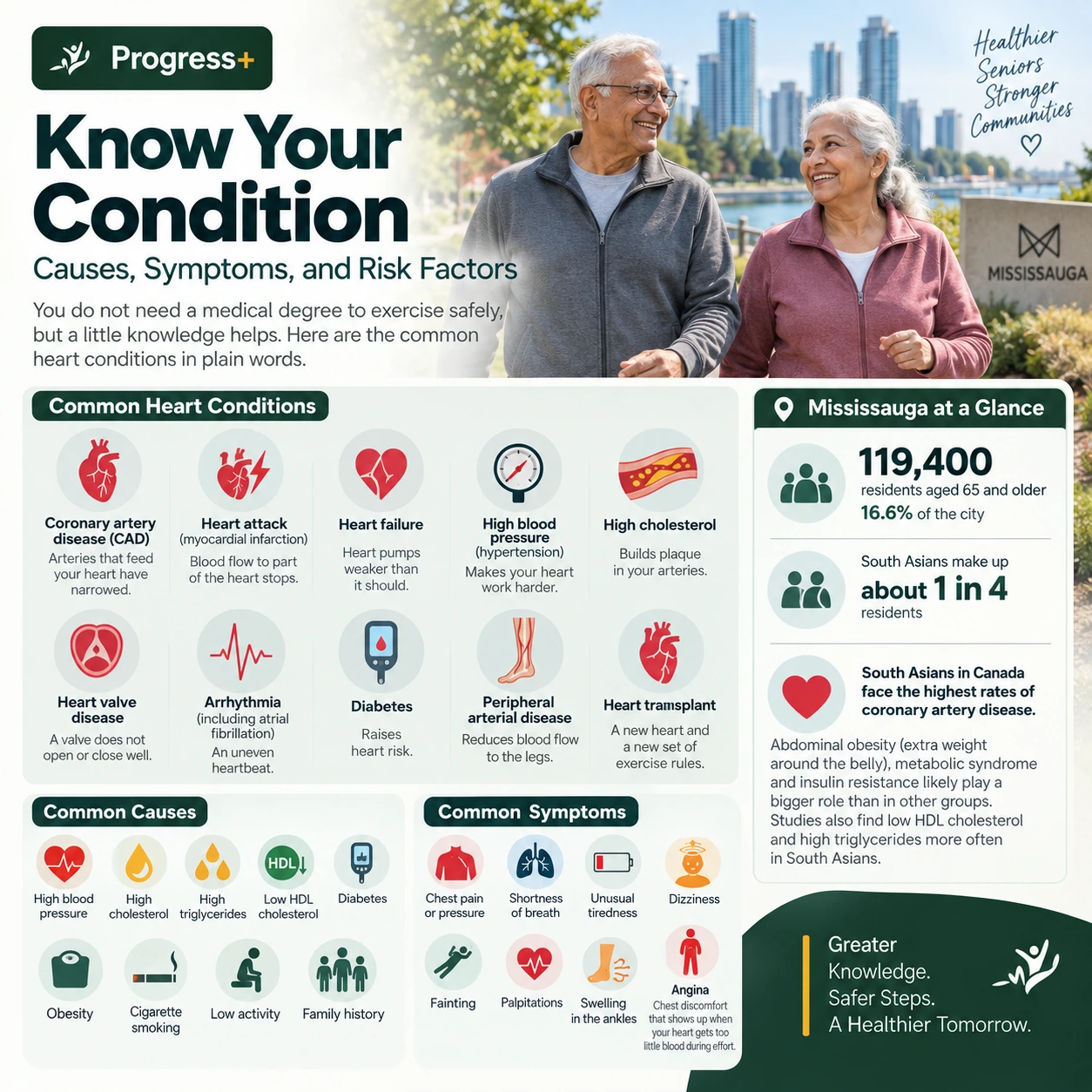
Coronary artery disease (CAD) means the arteries that feed your heart have narrowed. A heart attack, also called a myocardial infarction, happens when blood flow to part of the heart stops. Heart failure means the heart pumps weaker than it should. High blood pressure, also called hypertension, makes your heart work harder. High cholesterol builds plaque in your arteries. Heart valve disease means a valve does not open or close well. An arrhythmia is an uneven heartbeat, and atrial fibrillation is the most common kind. Diabetes raises heart risk. Peripheral arterial disease reduces blood flow to the legs. A heart transplant gives you a new heart and a new set of exercise rules.
The common causes of cardiac conditions include high blood pressure, high cholesterol, high triglycerides, low HDL cholesterol, diabetes, obesity, cigarette smoking, low activity, and family history.
The common symptoms of heart conditions include chest pain or pressure, shortness of breath, unusual tiredness, dizziness, fainting, palpitations, and swelling in the ankles. Angina is chest discomfort that shows up when your heart gets too little blood during effort.
Mississauga has about 119,400 residents aged 65 and older, which is 16.6% of the city. South Asians make up about one in four residents, and South Asians in Canada face the highest rates of coronary artery disease. Abdominal obesity, which means extra weight around the belly, along with metabolic syndrome and insulin resistance, likely plays a bigger role than in other groups. Studies also find low HDL cholesterol and high triglycerides more often in South Asians. We come back to this below.
Before You Start, Your Doctor Visit Checklist
When should I consult my doctor before exercising? Talk to your doctor before you start any new program, after any heart event, after any change in symptoms or medication, and before you raise your effort.
Your cardiologist follows guidance from groups such as the Canadian Cardiovascular Society, Heart & Stroke, and the University of Ottawa Heart Institute. If anything here differs from their advice, follow their advice.
Ask about the Get Active Questionnaire too. The Canadian Society for Exercise Physiology (CSEP) built it to help people with health conditions decide their next step. Your doctor may also order an exercise stress test. This test shows how your heart behaves under effort. It also shows your exercise tolerance, which means how much activity you can handle before symptoms appear.
Bring this list to your visit, your medication list with doses and times, your latest cardiologist letter and stress test results, your device settings if you have a pacemaker or ICD, and your recent blood pressure readings.
Then ask these questions, what heart rate or effort limit should I use, which movements should I avoid and for how long, how should heat, cold, and my medication change my plan, and which symptoms mean I stop, and which mean I call 911.
How Much Exercise Do You Need?
The American Heart Association exercise recommendations call for at least 150 minutes of moderate activity a week, often described as 30 minutes of exercise most days of the week. Heart & Stroke says 150 minutes each week is good for your heart. The Canadian 24 Hour Movement Guidelines ask adults 65 and older for at least 150 minutes a week of moderate to vigorous intensity aerobic activity, muscle strengthening activities twice a week, and balance activities.
Here is the part many pages leave out. The Canadian guidelines say they may not suit adults who live with a medical condition. They tell those adults to use the Get Active Questionnaire or ask a health professional. So treat 150 minutes as a destination, not a day one target.
A simple way to build your plan is the FIT formula, Frequency, how many days a week, Intensity, how hard you work, Time, how long each session lasts. Add the type of exercise, and you have what professionals call an exercise prescription. Think of it as a written plan that stays inside your cardiologist's limits. Keep moderate intensity activities as your base. Progress with gradual progression, add a few minutes only after your current level feels easy for a week or two.
How Hard Should You Work? Talk Test, Effort, and Beta Blockers
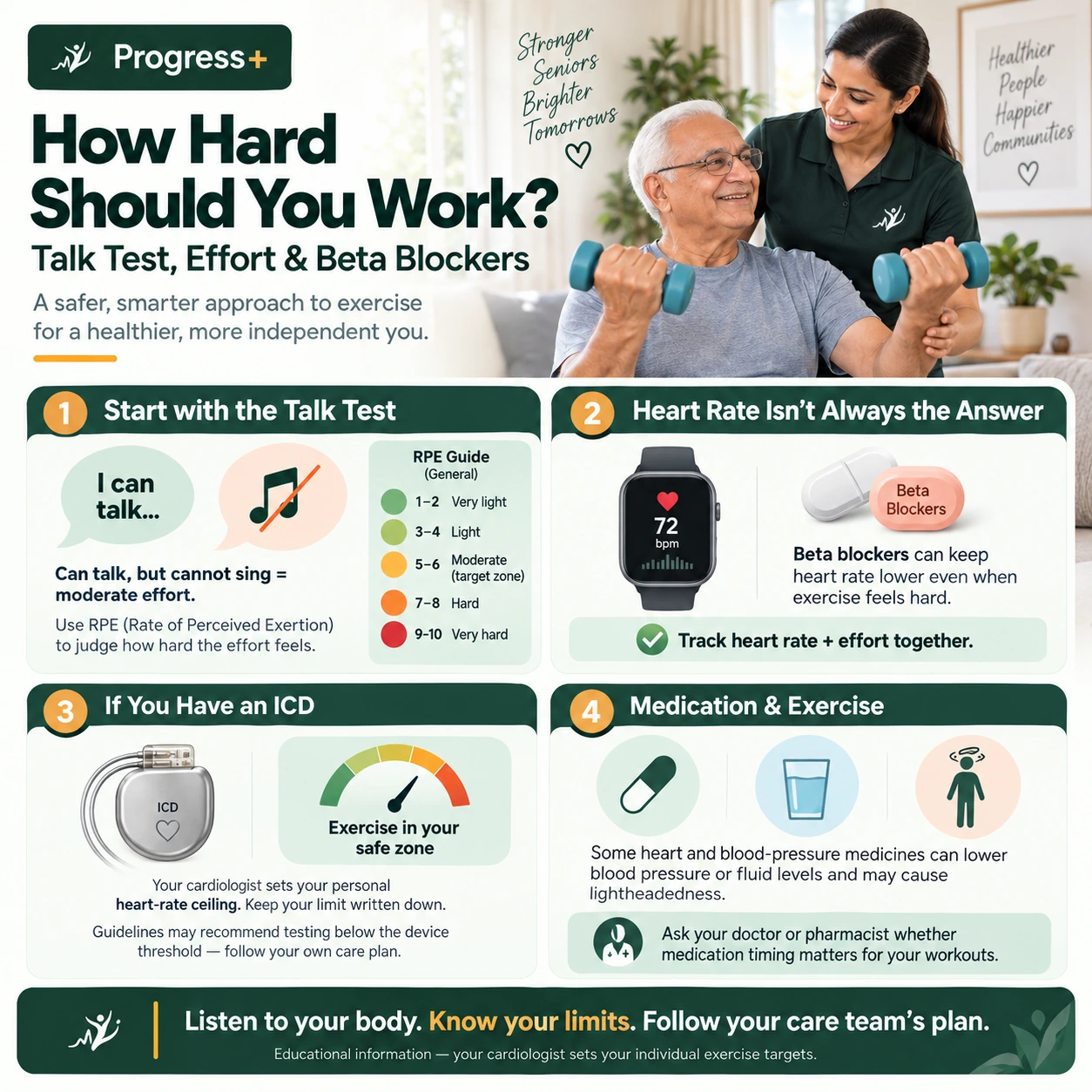
Start with the talk test. Use the talk test. If you can talk but cannot sing, you are likely at a moderate level. Add the rate of perceived exertion, or RPE, which is how hard the effort feels to you. Many programs aim for "somewhat hard," but your cardiologist sets the number that fits you.
Why the popular heart rate formula can fail you. You will see advice to work at 50 to 85 percent of maximum heart rate. That target zone is a general guide, and it may not fit you. Your heart rate target should come from your doctor, not from a chart. Beta blockers lower your heart rate at every workload, so your watch can show a low number while you work hard. Researchers who studied heart failure patients on beta blockers advise tracking heart rate and effort together.
An implantable defibrillator (ICD) adds another rule. Your device has a shock threshold, and guidelines suggest testing at 10 to 20 beats below it. Your cardiologist gives you a personal heart rate ceiling. Write it down and keep it with you.
A wearable or smartwatch helps you spot trends, but it does not guarantee safety. Trust your talk test and your effort level first, and use your resting heart rate and blood pressure response as extra clues for your care team.
Medication basics. Heart medication timing can change how you feel during exercise, so ask your doctor whether the time of your dose matters. ACE inhibitors, diuretics, and other blood pressure medication can lower your pressure or make you lose fluid. That can leave you lightheaded, especially when you stand up fast. Ask your pharmacist what to watch for.
Safe Cardio Routines for Seniors, The Activity Menu
The best heart healthy exercises for seniors are the ones you enjoy and repeat. Aerobic exercise for heart health means any steady movement that raises your breathing and heart rate. Aerobic exercises and aerobic conditioning build endurance exercises into your week. Choose low impact options first.
Gentle starters
Brisk walking, built up slowly from short walks, a walking program works well indoors or out, an indoor walking track at a City recreation centre, a stationary bike, water exercise or easy swimming, tai chi and chair exercises, slow dancing.
Steady builders
Once your team agrees, bicycling outdoors on flat routes, a rowing machine at a comfortable pace, stair climbing in short bouts, hiking on easy trails.
Only with your cardiologist's approval
Jogging, jumping rope. Both put more load on the heart and joints, so they rarely make a good starting point.
Is walking enough exercise after a heart attack? Walking is a great base, and many heart programs start there. Your doctor sets the amount. Add strength and balance work later so your whole body keeps up.
Heart healthy exercises for older adults also work as a family habit. Walk with a spouse, a neighbour, or a grandchild. Company keeps you consistent.
Strength, Balance, and Breathing
Myth, heavy weights are off limits. Some pages tell seniors with heart conditions to avoid weights completely. The evidence says otherwise. The American Heart Association's 2023 update on resistance training says it improves blood pressure, blood sugar, and blood fats, and older adults gain a lot. Strength training twice a week is part of the Canadian guidelines too.
Can seniors with heart disease lift weights? Many can, with a plan. Start with resistance bands or light weights. Keep your sets and reps low, and choose a load you can lift while breathing easily.
Breathe out on effort. Holding your breath while you lift, called the Valsalva manoeuvre, can push blood pressure up fast. Cardiac rehab guidance says to avoid it. Use exhale on effort, breathe out when you push or lift, and breathe in when you relax. One small study of older coronary patients found that short rests between repetitions lowered the strain on the heart. Take your time and rest between repetitions. These are also good breathing exercises for the warm up and the cool down.
Balance and falls. Balance training and falls prevention protect you from injuries that could stop your progress. Practice near a sturdy counter. Add chair exercises on low energy days. Ask about tai chi or gentle dance.
Exercise by Condition
Every heart is different. Follow your surgeon and cardiologist first, and use this section to prepare your questions.
Exercise after a heart attack for seniors
How soon can I exercise after a heart attack? Trillium says the right start time depends on your health history, the heart procedure you had, how long ago you left the hospital, and how well your recovery is progressing. Your care team decides. Seniors often begin with light walking under supervision.
Exercise after a stent or angioplasty for seniors
An angioplasty opens a narrowed artery, and a stent holds it open. Recovery is often quicker than after surgery, but you still need clearance and a gradual plan. Ask when you can raise your effort.
Exercise after bypass surgery in elderly patients
After CABG, or coronary artery bypass grafting, your surgeon cuts through the breastbone in a procedure called a sternotomy. Breastbone healing takes weeks, and sternal precautions limit how you push, pull, and lift with your arms. Can I lift weights after bypass surgery? Not until your surgeon and rehab team say yes. Then start light and build slowly.
Exercise after heart valve surgery or TAVI
Valve surgery and TAVI, a valve replacement done through a small opening in a blood vessel, each come with their own limits. Ask your surgeon how soon you can walk farther, and which arm movements to hold back.
Exercise with heart failure in the elderly
Studies show supervised exercise can help older adults with heart failure, including many with a weak pump, called a low ejection fraction. Start low, go slow, and report sudden weight gain, swelling, or new breathlessness to your team.
Exercise with atrial fibrillation for seniors
Many exercises stay safe with atrial fibrillation, but you need to work with a professional and know which symptoms need emergency help. Report an irregular heartbeat or palpitations that feel new.
Exercise with a pacemaker or ICD for seniors
Is exercise safe with a pacemaker or ICD? Often yes, with limits. After a device implant, ask about your arm and shoulder rules. One clinical review says to avoid upper body strength training for the first several months, because arm work can cause lead movement and loosen newly placed leads. In a large heart failure trial, exercise training did not increase ICD shocks. Still, keep your heart rate below the ceiling your cardiologist gives you.
Exercise with high blood pressure for seniors
Exercise helps lower blood pressure over time. Avoid breath holding, and check your readings as your doctor advises.
Exercise with angina for seniors
Stop and rest at the first sign of chest discomfort. Follow the medication plan your cardiologist gave you, and call 911 if symptoms do not settle.
Peripheral arterial disease and heart transplant
With peripheral arterial disease, one Mississauga clinic says aerobic activity can improve leg circulation and reduce pain. After a heart transplant, follow your transplant team's rules closely, because your new heart responds to exercise differently.
Warning Signs and Your Emergency Plan
Stop exercising right away if you feel chest pain, chest pressure, shortness of breath that is out of proportion, dizziness, palpitations, or fainting. Sit down and rest. When should I stop exercising and call 911? Call 911 if symptoms do not go away within a few minutes of rest, if they get worse, or if you faint.
Set up your emergency plan at home before you need it:
- Keep your phone charged and within reach, so phone access is never a problem.
- Write your home address near the phone and in your phone notes.
- Post your medication list and doctor's number on the fridge.
- Tell a family member or neighbour your exercise times.
- Ask family members to take a CPR course, and learn where the closest public AED hangs.
Programs in the Heart Wise Exercise network, which the University of Ottawa Heart Institute created, follow a six point safety standard. In person classes need CPR certified leaders, phone access to paramedics, and an AED on site. A home session usually has no AED on site, so ask any in home trainer, including us, to walk you through their emergency steps before session one. A cardiac safe program never treats that question as rude.
Safe Exercise Through Mississauga Winters and Summers
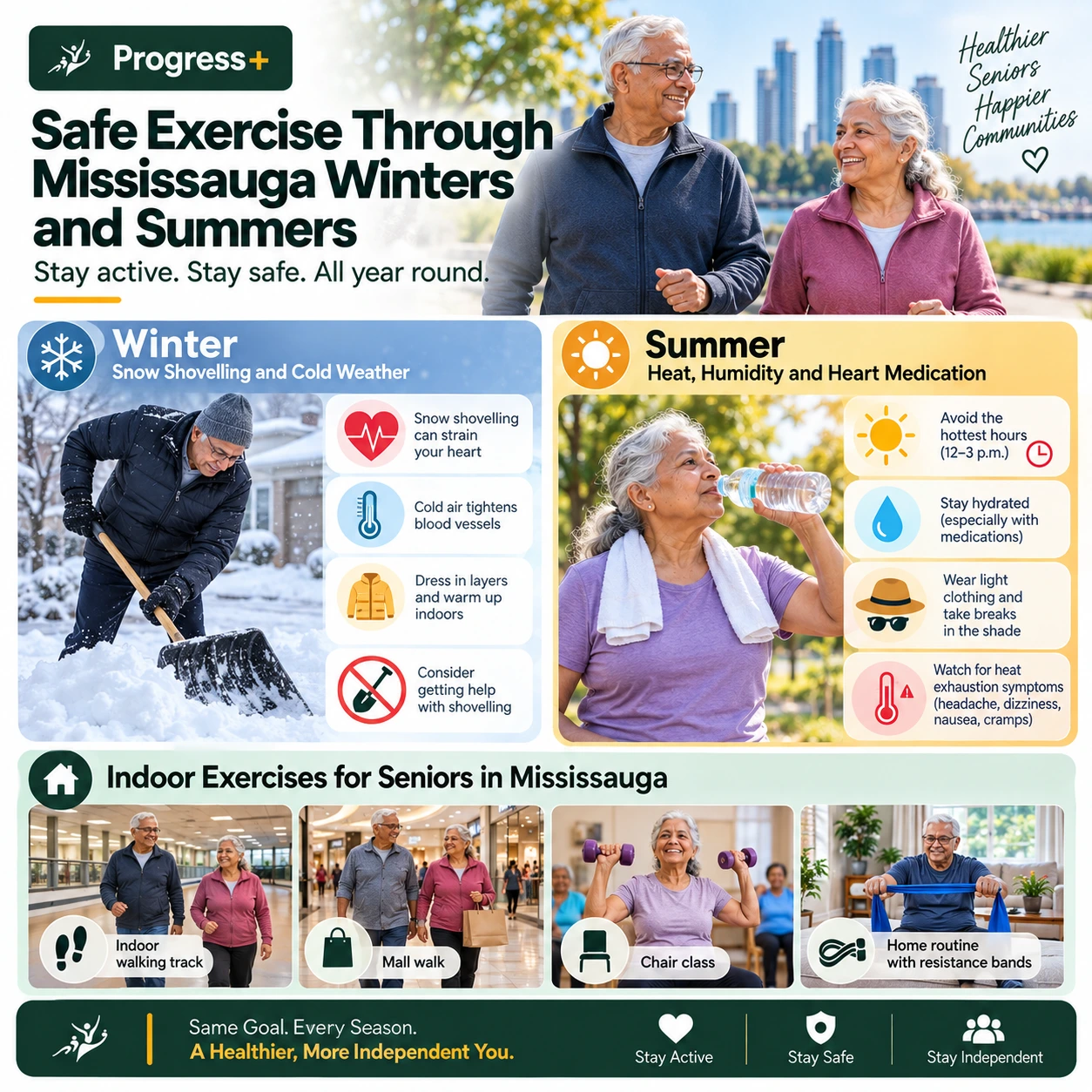
Winter, snow shovelling and cold weather. Ontario winter adds a real risk. Shovelling combines heavy arm work, cold air, and sudden effort. A large Canadian study found that snowfalls of more than eight inches went with 16% more heart attack admissions and 34% more heart attack deaths among men the next day. The study could not prove that shovelling caused the extra events, and it did not find the same pattern in women. Even so, it gives good reason to ask your cardiologist, is it safe to shovel snow with heart disease? Many people should hand that job to someone else. Cold air also tightens blood vessels, so dress in layers and warm up indoors before you go outside.
Summer, heat, humidity, and heart medication. Can I exercise in summer heat with heart medication? Often yes, with care. The American Heart Association says beta blockers, ACE inhibitors, ARBs, calcium channel blockers, and diuretics can exaggerate your body's response to heat. It also says to keep taking your medication unless your doctor says otherwise. A 2024 review found the lab evidence for some of these drugs is thinner than the warnings suggest, so use the warnings as a reason to talk to your doctor, not as a reason to panic.
Avoid the hottest hours, from about noon to 3 p.m. Wear light clothing and take regular breaks in the shade. Watch for heat exhaustion, headache, cool and clammy skin, a fast weak pulse, dizziness, cramps, nausea, or fainting. Move somewhere cooler and stop exercising. Heat stroke is an emergency, so call 911. Dehydration makes the heart work harder. Hydration matters, but if you have heart failure and a fluid limit, ask your care team how much to drink before you increase your water.
Indoor exercises for seniors in Mississauga. Indoor exercises for seniors keep you moving all year. Try a City indoor walking track, a mall walk, a chair class, or a home routine with resistance bands. Tell your trainer or class leader about your heart condition every time.
Culturally Aware Options for South Asian Seniors and Families
South Asian seniors carry a higher risk of heart disease, and diabetes and insulin resistance often add to it. Good advice respects your culture, your food, and your family. It should never assume anything about you.
Here is what culturally aware support can look like. Language, ask whether your trainer can explain your plan in your first language, whether that is Urdu, Gujarati, Hindi, or Punjabi. Clear instructions keep you safer. Women only options, many women feel more comfortable in women only classes or with a female trainer. Ask for it. Prayer positions and floor sitting, getting up from the floor can strain the knees and hips, and it can raise your effort fast. A trainer can teach easier ways to transfer, and you can use a chair or cushion. Vegetarian diets, a vegetarian pattern can suit heart health. Ask a dietitian to build a plan that fits your meals and your cholesterol goals. Multigenerational households, exercise can become a family habit. A short evening walk with the whole household counts.
Adult children and caregivers play a big part. If you look after an aging parent, offer to attend the doctor visit, help set up the emergency plan, and join the first session. Family involvement keeps everyone on the same page and makes the routine stick.
After Cardiac Rehab, How to Keep Your Gains
Cardiac rehab after care starts before you graduate, so ask your team for a plan. When rehab ends, the weekly supervision ends too, and that is where many people slip. One clinic notes that many patients finish rehab without a plan for what comes next and drift back to old habits. Cardiac recovery and heart attack recovery do not end on graduation day.
Build a ladder of support. Heart Wise Exercise classes, these community programs suit people who want to continue after cardiac rehab, and they follow the six point safety standard. Ask your rehab team about Heart Wise Exercise Mississauga classes near you. Community programs, the City's 65+ Fit membership is free for Mississauga residents aged 65 and older, and it includes indoor walking tracks, drop in classes, and a free 45 minute consult with a City trainer. The Active Adult Centre of Mississauga offers classes for adults 50 and older, including a chair based class that works the heart and muscles. Supervised training at home, a Registered Kinesiologist can guide exercise after cardiac rehab in Mississauga, track your progress, and change your plan when your fitness grows. Your own routine, self management means you know your numbers, your medication, your symptoms, and your limits. A maintenance program of walking, strength, and balance keeps you steady.
Toronto Rehab runs a maintenance program called Heart Health for Life for rehab graduates. Ask your rehab team what similar community exercise programs exist near you.
How to Spot a Cardiac Safe Program
We know of no official cardiac safe label in Ontario, so use a checklist. Cardiac safe exercise programs, whether a class or a trainer, should do the following. Hold every provider to this standard, because cardiac safe exercise Mississauga seniors can trust starts with clear answers.
- Ask for physician clearance and screen every participant.
- Include a warm up, a cool down, and self monitoring in every session.
- Offer easier and harder versions so you can work at a safe level.
- Accept people with heart disease and explain any limits.
- Keep a written emergency plan that every leader knows.
- Ask for your medication list and update it.
- Explain how your medication, device, and conditions change your targets.
- Stay in touch with your doctor, with your permission.
- Use a regulated professional, in Ontario, Registered Kinesiologists answer to the College of Kinesiologists of Ontario.
- Speak in a language you understand.
If you want an in home personal trainer for seniors in Mississauga, or a personal trainer for seniors with a heart condition, use this list in the first phone call. The same goes for a fitness trainer for the elderly or any personal trainer for seniors in Mississauga. Good ones welcome your questions.
Cardiac Exercise in Mississauga, Resources Near You
Check each listing on its official page before you go, because hours and rules change.
Trillium Health Partners cardiac rehab. The Cardiovascular Wellness and Rehabilitation Centre runs at Queensway Health Centre and at the University of Toronto Mississauga campus. You need a doctor's referral. Trillium also runs cardiac services at Credit Valley Hospital, which serves north Mississauga, including Erin Mills. Ask your doctor which site fits you best.
Heart Wise Exercise. Look for the logo at community classes across the Mississauga region.
Mississauga 65+ Fit membership. It is free for residents 65 and older. It opens the door to senior fitness Mississauga wide, from walking tracks to Mississauga senior fitness classes, plus a free trainer consult. The Mississauga Seniors' Centre is one of 13 locations.
Active Adult Centre of Mississauga. It sits in Central Parkway Mall on Burnhamthorpe Road East, and it offers active classes for adults 50 and older.
Heart & Stroke. The foundation offers guides on staying active with heart disease and stroke.
Wherever you live, from Port Credit and Lorne Park to Streetsville, Meadowvale, Erin Mills, Cooksville, Clarkson, Malton, and the Square One area, these options sit within reach.
How Progress Plus Fits In
Our in home personal training in Mississauga is not cardiac rehab, and we never pretend it is. We help you exercise safely between doctor visits, after rehab, and alongside your care team. Here is how it works. We start with a free consultation and a baseline assessment. We ask for your physician's clearance and your medication list. We run monitored exercise sessions, check blood pressure and effort, and follow any limits your cardiologist sets. We do progress tracking, and with your consent we coordinate with your physician and share updates. Many seniors train two to three times a week, and your plan changes as you improve.
Our Heart & Blood Pressure program has the details. Our team includes Registered Kinesiologists who work under the College of Kinesiologists of Ontario. That gives you a regulator you can contact, and it means we tell you plainly when something needs your doctor instead.
Ready to talk? Book a free assessment or call 416 553 0838. Bring your questions, your medication list, and a family member if you like.
Frequently Asked Questions
Is it safe to exercise with a heart condition?
How soon can I exercise after a heart attack?
What heart rate is safe on beta blockers?
Can I lift weights after heart surgery?
Is exercise safe with a pacemaker or ICD?
When should I stop exercising and call 911?
Is it safe to shovel snow with heart disease?
Can I exercise in summer heat with heart medication?
What can I do after cardiac rehab ends?
Do I need a doctor's referral for cardiac rehab in Ontario?
Conclusion
Living with a heart condition does not mean living on the sidelines. It means learning your body's new rules and then getting back to the life you enjoy, just with a bit more care built in.
That is really what this whole guide comes down to. Talk to your cardiologist first. Learn to read your own effort instead of chasing a number on a screen. Know your warning signs cold, and never feel silly asking a trainer or a class leader what their emergency plan looks like.
You also do not have to figure this out alone. Between Mississauga's own hospital rehab programs, the free 65+ Fit membership, community classes, and supervised in home support, there is real help close by, whatever stage you are at. Whether you are just starting out, working your way back after a hospital stay, or trying to keep the progress you already fought hard for, there is a safe next step waiting for you.
So start small. One conversation with your doctor. One short walk this week. One honest question to whoever guides your next workout. Your heart carried you this far, and with the right care, it can carry you a long way further.