This article shares general education only. It does not replace advice from your doctor. Please get medical clearance before you start any new exercise program, especially if you live with rheumatoid arthritis, a swollen joint, a recent joint surgery, or a history of falls. Registered Kinesiologists guide exercise. They do not diagnose conditions.
Summary
Stiff knees when you swing your legs out of bed. A jar lid that just will not give. Stairs that seem to get a little steeper every winter. If arthritis has you wondering whether exercise will help or make things worse, you are not alone in asking, and the answer is more hopeful than most people expect. For the majority of adults with osteoarthritis, gentle strength training genuinely eases joint pain and stiffness rather than adding to it. Stronger muscles act like a natural brace around a sore knee, hip or hand, taking pressure off the joint itself, and that same strength work supports bone density and the kind of balance that keeps you steady once Mississauga sidewalks ice over. You also do not need to lift heavy to get there. A major clinical trial found that light resistance training relieved knee osteoarthritis pain just as well as heavy lifting did, and Canadian exercise guidelines only ask for two short sessions a week to begin.
In this guide, we walk through what the research really says, how to tell ordinary muscle soreness apart from joint pain that deserves a pause, and what a beginner friendly week looks like with nothing more than a sturdy chair and a resistance band. We also cover how to adjust safely during a flare up, plus honest, local options across Mississauga, from the City's free 65+ Fit membership to one on one in home training with a Registered Kinesiologist. One thing we want to say plainly, this article is meant to educate, not replace your doctor. Please get medical clearance before starting anything new, especially if you live with rheumatoid arthritis, a swollen joint, or a recent surgery.
Key Takeaways
Strength training eases pain, it does not add to it. Stronger muscles act like a natural brace, taking real pressure off a sore knee or hip during everyday moves.
Heavy weights are not required. A major trial found light training relieved knee osteoarthritis pain just as well as heavy lifting, so consistency beats intensity.
The research backs this up beyond one study. A 2023 Arthritis & Rheumatology study linked a strength training history to noticeably lower odds of frequent knee pain.
Two short sessions a week is enough to start. Canadian guidelines recommend muscle strengthening twice weekly, with a rest day between sessions to let joints recover.
Total rest often backfires. Long stretches of sitting weaken muscles, stiffen joints, and quietly worsen your balance, raising your fall risk instead of lowering it.
Learn to read your pain signals. Mild soreness settling within a day is normal, but joint pain lasting past 24 hours means you pushed too hard.
A flare up needs a lower dose, not a full stop. Reduce your load, switch to isometric holds or water based exercise, and rest a hot, swollen joint while calling your doctor.
Cold winters stiffen joints indirectly, not directly. Winter does not damage your joints, but it keeps you indoors and sitting still, which is what actually causes the stiffness.
Mississauga offers real, nearby options. From the free 65+ Fit membership to in home training with a Registered Kinesiologist, there is a starting point for every comfort level.
Get medical clearance and choose support carefully. Your arthritis type changes the plan, so look for a regulated professional who explains their credentials and adjusts as you progress.
Introduction
Your knees need a minute before they agree to move. The jar lid wins. The stairs to your bedroom feel taller than they did last winter. And every time you think about exercise, one worry stops you cold, what if movement makes my arthritis worse?
Here is the good news. Gentle strength training is one of the most evidence backed ways to reduce joint pain and joint stiffness, and thousands of older adults across Mississauga already use it to move through their day with less trouble. Light resistance training protects your joints instead of wearing them out. It also builds the balance and confidence you need on icy sidewalks.
In this guide you will find, how common arthritis, osteoarthritis and rheumatoid arthritis really are in Ontario and Peel Region, why muscle strength eases joint load, and what the research actually proves, the safest gentle exercises for arthritic joints, including resistance bands, chair based exercises and water based exercise, a two day beginner weekly plan with sets and reps, a flare up decision guide and a pain scale progression system, exercises to avoid with arthritis, plus warning signs to stop, and winter joint pain in Mississauga and your local options, from the free 65+ Fit membership to in home personal training.
The Clear Answer
Is gentle strength training safe for arthritis? For most adults with osteoarthritis, yes, and this isn't just reassurance, it's backed by real evidence. Training your muscles just two days a week, at a comfortable effort of about 6 or 7 out of 10, using resistance bands, bodyweight moves or chair based exercises, has been linked to less joint pain, better mobility, and a lower risk of falling.
You genuinely don't need heavy weights to see these benefits either. A large randomized controlled trial found that light, low load training worked just as well as heavy lifting for easing knee osteoarthritis pain, which means there's no reason to push yourself into something that feels wrong for your body. Mild soreness that fades within 24 hours is a completely normal part of the process. Sharp joint pain, swelling or a feeling of instability is a different story though, and that's your body's clear signal to stop.
The one thing we'd never skip is getting medical clearance first. From there, let a physiotherapist or Registered Kinesiologist build the plan around your specific diagnosis and your joints, not a routine copied from someone else's situation.
How Common Is Arthritis in Mississauga and Ontario?
Arthritis is not a rare condition that happens to other people. It sits in almost every street in Peel Region.
The numbers at a glance
Where
What the data shows
Canada
More than 6 million Canadians live with arthritis, about 1 in 5 adults (Arthritis Society Canada).
Canada, 2040
Cases are projected to reach roughly 9 million.
Adults 65+
Close to half of people over 65 live with arthritis.
Mississauga, 2021
About 119,400 residents were aged 65 and over, roughly 16.6% of the population (Statistics Canada).
Put those two facts together and the picture gets clear. In a city with nearly 120,000 older adults, joint pain shapes daily life in tens of thousands of Mississauga homes, from Port Credit to Malton.
Osteoarthritis vs Rheumatoid Arthritis vs General Joint Pain
Your type of arthritis changes your exercise plan, so it helps to know the difference. Only your doctor can diagnose you.
Osteoarthritis vs Rheumatoid Arthritis vs General Joint Pain
Type
What happens
Morning stiffness
How exercise fits
Osteoarthritis
Cartilage wears down over years, usually in knees, hips and hands.
Usually eases within 30 minutes.
Strength training and low impact exercise sit at the centre of care.
Rheumatoid arthritis and other inflammatory arthritis
Your immune system attacks the joint lining, often in a symmetrical pattern.
Often lasts an hour or more, sometimes with fatigue or fever.
Medication plan comes first, then exercise works alongside it, adjusted around flares.
General joint pain
Comes from overuse, past injury, weak muscles or tendon irritation.
Varies.
Often responds quickly to muscle strengthening and range of motion work.
If your stiffness drags past an hour, or you feel unusually tired and unwell, book a visit with your family doctor. In Ontario you need a referral from your family physician to see a rheumatologist.
Why Gentle Strength Training Relieves Arthritis and Joint Pain
Muscle Support and Joint Load
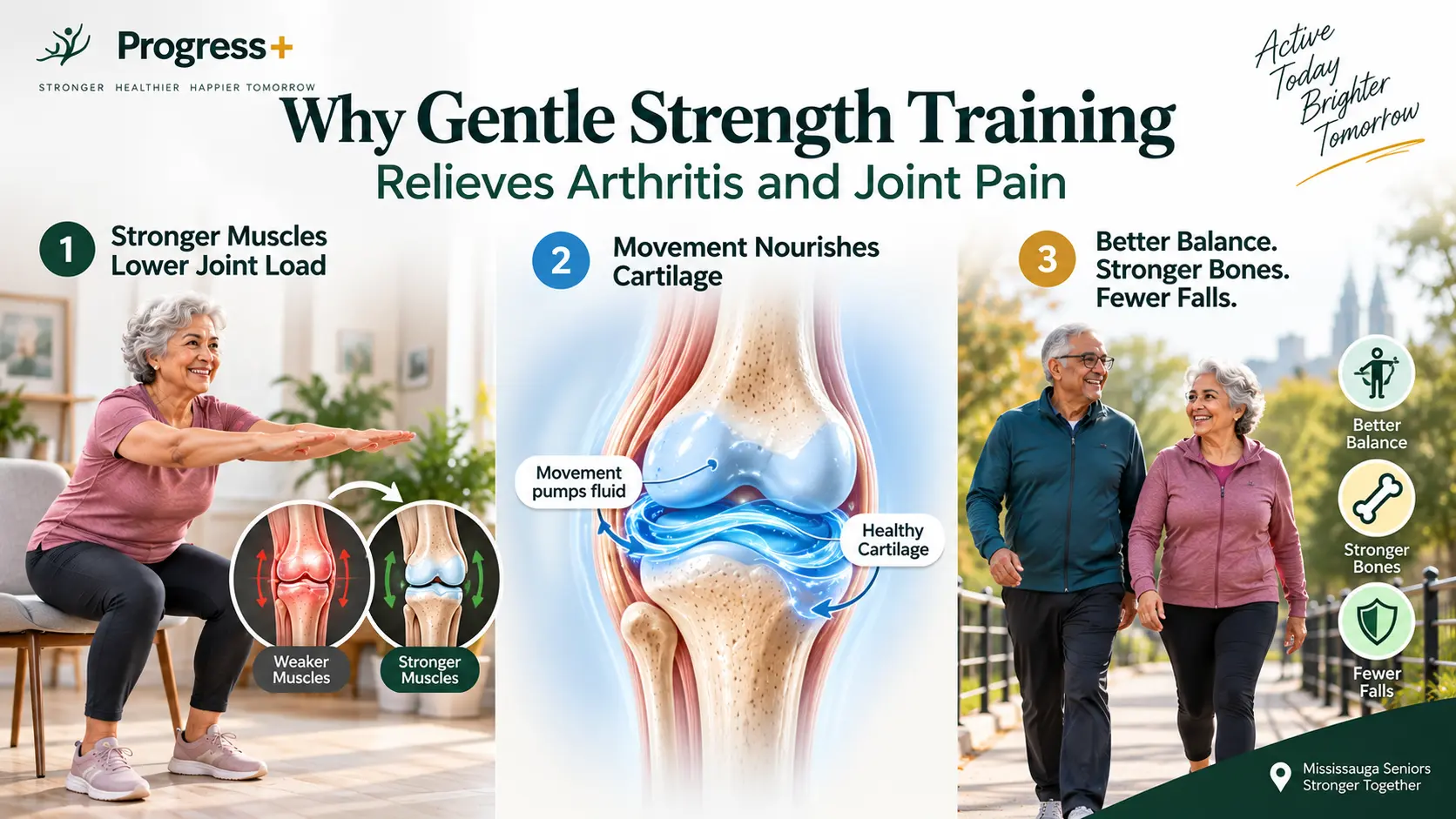
Here's the thing about joints, they never really work alone. Stand up from a chair right now and notice what happens. Your quadriceps, glutes and calves all jump in to share that effort with your knee. So when those muscles get weaker over time, your knee ends up absorbing a bigger share of the load, and a lot of that lands straight onto cartilage that's already worn thin.
A useful way to think about it is that strong muscles act like a brace around the joint, one your body builds for free. Strengthen that brace, and the same staircase, the same bag of groceries, the same walk to the car suddenly asks less of your knee. It also explains something a lot of people notice without knowing why, arthritis tends to feel a bit worse each year as we age. Part of that comes down to sarcopenia, the natural muscle loss that comes with getting older. The good news is resistance training is genuinely one of the only things that turns this around instead of just slowing it down.
Cartilage Nutrition and Joint Lubrication
This part surprises most people the first time they hear it. Cartilage doesn't have its own blood supply. Instead, it relies on synovial fluid, the thick fluid sitting inside your joint capsule, to get fed. And movement is what actually pumps that fluid across the cartilage so it can do its job.
Stay still for a couple of weeks and that pump slows down noticeably. Move gently and often, and you'll usually feel your joints loosen up within minutes, not days. That's really why a short walk leaves your knees feeling better, while a long afternoon parked in a recliner leaves them stiffer.
Balance, Fall Prevention, and Bone Density
Strength work isn't only about pain relief either. It sharpens your balance and coordination, keeps your joints more stable, and puts healthy load through your bones in a way that supports bone density. If you're in Mississauga, this becomes especially important between December and March, when driveways turn to ice and one wrong step can set you back for months.
Honestly, fall prevention and joint pain relief aren't two separate goals. They're the same work wearing different names. Strengthen the legs and hips that carry you through the day, and you end up protecting both at once.
What the Research and Guidelines Say
We'd rather show you the actual evidence than just ask you to take our word for it, so here's what the research says.
A 2023 study in Arthritis & Rheumatology by Lo and colleagues looked at adults with a history of strength training and found something worth paying attention to, they were about 17% to 23% less likely to deal with frequent knee pain or knee osteoarthritis than those without that history.
Then there's the START trial, published in JAMA, which followed 377 adults over 50 with knee osteoarthritis for a full 18 months. What it found surprised a lot of people in our field. Lifting heavier didn't actually beat lifting lighter when it came to knee pain or function. If anything, the heavier group ran into more minor issues along the way, 53 reported, compared with just 30 in the lighter group. That's a big part of why we don't push people toward heavy loads just because it feels like more effort should mean more benefit.
On the guideline side, CSEP and the Canadian 24 Hour Movement Guidelines call for muscle strengthening at least two days a week for adults and older adults, and ACSM lines up with similar advice. The 2019 guideline from the American College of Rheumatology and Arthritis Foundation goes even further, strongly recommending exercise and tai chi for knee and hip osteoarthritis, and it specifically points out that supervised programs tend to get better results than going it alone.
We think it's only fair to be upfront about a limit here too. Most of this research focuses on knee osteoarthritis specifically, and outcomes can look a bit different for hand arthritis, hip arthritis or inflammatory arthritis. That's exactly why we never hand out a one size fits all routine. Your plan should be built around your joints, not someone else's research summary.
The Safest Gentle Exercises for Arthritic Joints
Resistance Bands
Bands give you smooth, low load training with no impact, and you control the tension by shortening or lengthening the band. They suit hand arthritis well, because you can loop the band around a soft wrist strap instead of gripping it.
Bodyweight Exercises
Sit to stand, wall push ups and calf raises need no equipment and train the exact movements you use at home. Start with a higher chair or a wall if the full version hurts.
Chair Based Exercises
A sturdy chair takes balance out of the equation so you can focus on the muscle. This is the safest entry point if you feel unsteady, if you have had a fall, or if you are returning after surgery.
Water Based Exercise
Warm water carries most of your body weight, so painful knees and hips move freely. Many Mississauga pools run aquafit classes for older adults. Water is a great flare week option, although it does less for bone density than land based training.
Best starting option by joint concern
Your joint concern
Best starting option
Why it works
Knee osteoarthritis
Chair based and bodyweight
Trains quadriceps with a controlled range of motion and no jarring.
Hip arthritis
Resistance bands, standing with support
Side and back leg work builds glutes without deep hip bending.
Hand and wrist arthritis
Soft bands, putty, wrist straps
Removes hard gripping while still building forearm and grip strength.
Balance worries or recent fall
Chair based, then counter supported standing
Keeps a support point within reach at all times.
Widespread pain or active flare
Water based and isometric exercises
Unloads the joint and lets you keep moving through a flare.
Thinning bones alongside arthritis
Bodyweight and band work on land
Load through the skeleton supports bone density.
Sets, Reps, Tempo, and Frequency
Let's keep the numbers simple enough that you'll actually remember them.
Sets and reps. Start with just 1 set of 8 to 12 reps. That's it. Once your joints tell you they're handling that comfortably, build up to 2 or 3 sets. There's no prize for rushing this part.
Effort. Aim for about a 6 or 7 out of 10 on how hard it feels. The last rep or two should feel like real work, the kind where you're focusing a little harder, but it should never tip over into pain. If it does, that's your body asking you to back off, not push through.
Tempo. Move slowly and stay in control, roughly 2 seconds on the way up and 3 seconds on the way down. It's tempting to rush through reps to get the set over with, but slow genuinely works better for sore joints, and it gives you far more control over what your body is doing.
Frequency. Two sessions a week is the sweet spot most guidelines point to, with about 48 hours between sessions that hit the same muscles so your body actually has time to recover and adapt. If two sessions feels like a lot right now, one is still a completely legitimate place to start. We'd rather you begin small and stay consistent than burn out chasing an ideal number.
Progressive overload. When your current routine starts to feel easy, and only then, increase your load, reps or time by 10% to 20%. Small, steady increases protect your joints far better than jumping ahead because you're feeling motivated on a good day.
One rule we never bend. Never lock out your knees or elbows at the top of a movement. It's a small habit, but it's one of the easiest ways to take unnecessary strain off a joint that's already working hard enough.
A Sample Beginner Weekly Gentle Strength Plan
Use this as an education template. Ask your doctor for clearance and ask your Registered Kinesiologist or physiotherapist to adjust it for your joints.
What you need, a sturdy chair, a light resistance band, a kitchen counter, a wall, and two light weights. Soup cans work perfectly on week one.
Schedule, Monday and Thursday for strength. Walking, tai chi or gentle range of motion on other days. Keep rest days between strength sessions.
Warm up, 5 minutes, both days. March gently on the spot for 2 minutes, then add slow arm circles, shoulder rolls and ankle circles. You want warm muscles and easy breathing before the first set.
Day 1, lower body and posture
Day 1, lower body and posture
Exercise
Sets and reps
Tempo
Rest
Sit to stand from a chair
1 to 2 sets of 6 to 10
2 up, 3 down
60 seconds
Wall push ups
1 to 2 sets of 8 to 12
2 and 2
60 seconds
Calf raises at the counter
2 sets of 10 to 12
2 up, 3 down
45 seconds
Banded rows, seated
2 sets of 10
2 and 3
60 seconds
Standing weight shifts, balance
2 sets of 30 seconds
Slow
30 seconds
Day 2, hips, arms and stability
Day 2, hips, arms and stability
Exercise
Sets and reps
Tempo
Rest
Seated leg extensions, no weight first
2 sets of 8 to 12 each side
2 up, 3 down
60 seconds
Banded hip abduction, standing with support
2 sets of 8 to 10 each side
2 and 3
60 seconds
Seated shoulder press with band
2 sets of 8 to 10
2 and 3
60 seconds
Isometric wall sit, shallow angle
3 holds of 10 to 20 seconds
Hold
45 seconds
Single foot stand at the counter
2 sets of 10 seconds each side
Slow
30 seconds
Cool down, 3 minutes. Walk slowly around the room, then hold easy calf, thigh and shoulder stretches for 20 seconds each. No bouncing.
Scaling to three days, once two sessions feel comfortable for three straight weeks, add a third day and keep the same loads. Add volume before you add weight.
Ask your kinesiologist for a printed one page version of this plan so you can tick off each session on the fridge. People who track their sessions stick with them.
Exercising During an Arthritis Flare Up
A flare up does not mean you stop moving. It means you change the dose. Read down this guide and pick your row.
Green
Keep going
Joints feel normal or mildly achy. Yesterday's session settled within 24 hours. Train as planned. Add 10% when the current level feels easy.
Yellow
Reduce and modify
Joint pain builds during the set. Stiffness lingers past 24 hours. The joint feels warm but not hot. Cut the load and reps by half. Swap weights for isometric exercises and range of motion work. Try water based exercise. Keep the session short.
Red
Rest and call
The joint is hot, visibly swollen and acutely painful. You have fever with joint pain, a joint that gives way, or pain after a fall. Stop training that joint. Rest one to two days, use active rest for the rest of your body, and call your doctor if it does not settle.
After a red day, restart at roughly half your last comfortable level and build back over a week. Do not jump straight back to where you left off. That single habit prevents most repeat flares.
The Pain Scale Progression System and Safety Checklist
Vague advice like "listen to your body" does not help when you are standing in your living room with a band in your hand. Use numbers instead.
Rate your joint pain from 0 to 10
0 to 3 during, back to baseline next morning — this is your green zone. Progress by 10% to 20% next week.
4 to 5 during, settles within 24 hours — hold at the current level for another week. Do not add load yet.
6 or more during, or still elevated the next morning — you crossed into overexertion. Drop back one level, shorten the session and add a rest day.
Sharp, sudden or stabbing pain at any number — stop the movement immediately.
Mild soreness versus joint pain. Muscle soreness feels broad, dull and spread across the muscle belly, and it usually shows up a day later. Joint pain feels sharp, local and sits right inside the joint line. Soreness is a sign of adaptation. Joint pain is a sign of load.
Pre start safety checklist
Medical clearance from your doctor, especially with rheumatoid arthritis, recent surgery or other chronic conditions.
A five minute warm up, every session, no exceptions.
Supportive footwear with a grippy sole, not slippers.
Water beside you, and hydration before and after.
A stable chair or counter within arm's reach.
A phone nearby if you train alone.
A clear stop rule you have written down.
Exercises to Avoid With Arthritis and Warning Signs to Stop
Exercises to avoid with arthritis, jumping, hopping and plyometrics, running on concrete or other hard surfaces, deep squats and deep lunges that grind a painful knee, heavy loads pushed to failure, especially overhead, repetitive jarring motion such as long descents on stairs, any exercise that loads a hot, swollen joint, locking out knees and elbows under load.
Stop and get medical advice if you notice, severe or sudden joint pain, significant swelling, heat or redness, a joint that gives way or feels unstable, numbness, tingling or a locking joint, chest pain, dizziness or unusual shortness of breath, pain that keeps you awake at night after a session.
When to See a Doctor, Physiotherapist, or Kinesiologist First
Some people can start a gentle home routine today. Others need an assessment first.
Get medical clearance before you begin if you have rheumatoid arthritis or another inflammatory arthritis, a recent joint surgery or replacement, a joint that swells regularly, major deconditioning after illness, osteoporosis, uncontrolled blood pressure or diabetes, or a recent fall. About four in five Canadians with arthritis live with at least one other chronic condition, so your exercise plan needs to fit your whole health picture.
Who does what. Your family doctor diagnoses and clears you. A physiotherapist assesses the joint and treats acute injury or post surgical recovery. A physiatrist manages complex rehabilitation. A Registered Kinesiologist builds and supervises the ongoing exercise program, and in Ontario that title is regulated by the College of Kinesiologists of Ontario, so you can verify credentials. A certified trainer or exercise specialist can be excellent, but the title is not regulated, so ask more questions.
The GLA:D Program and Arthritis Programs in Ontario
GLA:D Canada pairs patient education with a supervised group exercise program for hip and knee osteoarthritis. It came to Canada in 2017 and usually runs through physiotherapy clinics, so ask your local clinic whether they offer a session. Arthritis Society Canada also runs the Arthritis Rehabilitation and Education Program for Ontario residents, which combines rehabilitation support with self management education.
The Mississauga Angle, Winter Joint Pain and Staying Active in the Cold
Ask any group of Mississauga seniors in January and half of them will tell you the cold gets into their knees. The research is more careful than that.
Several studies link lower temperatures, higher humidity and shifting barometric pressure to more osteoarthritis pain, and a 2023 review of 14 studies found that pattern. Other studies find no clear link. Here is the part everyone agrees on, cold weather does not damage your joints or wear out cartilage. What winter really does is keep you indoors and sitting, and less movement means stiffer joints, weaker muscles and shakier balance by March.
Icy sidewalks add the second problem. Fear of falling keeps people home, and staying home is exactly what weakens the legs that prevent falls.
A winter routine for Mississauga seniors, stretch your warm up to 8 or 10 minutes when the house feels cold, move your sessions indoors and keep them at the same two days a week, add balance training to every session, since ice punishes poor balance most, layer up and keep sore knees and hands warm before you start, practise a controlled sit to stand, because getting out of a car in a snowy lot is the same movement, book in home training on weeks when driving feels risky, keep hallway walking as your bad weather backup plan.
Local Options, In Home Training vs Gym vs Community Programs
Local options comparison
What matters
In home personal training
Gym or fitness centre
Community program
Supervision
One on one, Registered Kinesiologist
Varies, often shared attention
Group instructor, less individual attention
Personalization for arthritis
Built around your diagnosis, home and health history
Depends on the trainer's arthritis experience
General programming for a mixed group
Convenience
No travel, no parking, no winter driving
Travel each visit
Travel plus fixed class times
Cost
Highest per session, often insurance eligible
Membership plus trainer fees
Lowest, sometimes free
Social contact
Private
Moderate
Strongest
Best for
Pain, mobility limits, post surgery, transport barriers
Independent movers who like equipment
Confident movers who want routine and company
Many Mississauga families combine two. A community class for company and momentum, plus in home sessions for the technical work on a painful knee.
The Free 65+ Fit Membership and the Mississauga Seniors' Centre
The City of Mississauga launched its free 65+ Fit membership on April 1, 2025 for residents aged 65 and over. It includes drop in group exercise classes across city locations, a free 45 minute consultation with a personal trainer, and a discount on registered therapeutic classes. The Mississauga Seniors' Centre runs both in person and virtual options. The Active Adult Centre of Mississauga serves adults 50 and over with classes and social programs, and it lets you try a few visits before you commit. Check current details and locations on the City of Mississauga site before you plan around them, since programs change.
Wherever you live, from Erin Mills and Streetsville to Meadowvale, Clarkson, Lorne Park, Cooksville and Mineola, the same options apply, and in home services usually extend into Brampton, Oakville and Etobicoke.
Questions to Ask a Senior Trainer Before You Start
Are you a Registered Kinesiologist, and can I verify your registration?
What is your experience with osteoarthritis and rheumatoid arthritis specifically?
Will my sessions be insurance eligible under extended health benefits?
What does your first assessment include, and does it cost anything?
How do you measure progress, and how often do you retest?
What exactly do you change when a joint flares up?
Will you coordinate with my family doctor or physiotherapist?
What is your plan after a fall or a hospital stay?
A good professional answers all eight without hesitating.
Myths vs Facts About Arthritis and Strength Training
Myth Strength training is bad for arthritis. Fact It is one of the first line recommendations in clinical guidelines, and a history of strength training is linked to a lower likelihood of knee osteoarthritis.
Myth Rest is best during a flare up. Fact Complete rest weakens the muscles that protect the joint. Gentle movement, isometric holds and range of motion work usually help more, unless the joint is hot and swollen.
Myth Lifting weights wears out your joints. Fact Controlled, progressive loading strengthens the muscles, tendons and bone around the joint. Poor technique and sudden heavy jumps cause problems, not resistance training itself.
Myth You should feel results in a week. Fact Pain, mood and energy can improve early, but most people need about 10 to 12 weeks of consistency before strength and daily function change clearly.
Frequently Asked Questions
Is strength training safe for seniors with arthritis?
For most seniors with osteoarthritis, yes. Get medical clearance first, start with one light set, and work at about 6 or 7 out of 10 effort. Supervised programs produce better outcomes, so a Registered Kinesiologist or physiotherapist is worth the first few sessions.
What exercises should you avoid with arthritis?
Avoid jumping, running on hard surfaces, deep squats that grind a painful knee, repetitive jarring motion, and any heavy load pushed to failure. Never train a hot, swollen joint. Skip movements that cause sharp pain rather than working through them.
Can you exercise during an arthritis flare up?
Usually yes, with a lower dose. Cut load and reps, switch to isometric exercises, range of motion work or water based exercise, and keep the session short. If the joint is hot, swollen and acutely painful, rest it for a day or two and call your doctor.
How long does it take for exercise to help arthritis?
Many people notice less stiffness and better mood within two to three weeks. Measurable strength and daily function changes usually take about 10 to 12 weeks of consistent training. Keep a simple log so you can see the progress you cannot feel day to day.
How often should seniors strength train?
At least two days a week, which matches Canadian and ACSM guidance. Leave roughly 48 hours between sessions that work the same muscles. If you are brand new, one weekly session is a legitimate starting point, and you can build from there.
Does exercise make arthritis worse or damage joints?
Correctly dosed exercise does not damage joints. Pain that rises during a session and settles within 24 hours is normal adaptation. Pain that stays elevated the next morning means you did too much, so reduce the load rather than quitting altogether.
How do I start exercising with arthritis as a beginner?
Get your doctor's clearance, then pick two exercises such as sit to stand and wall push ups. Do one set of 6 to 10 reps, twice a week. Rate your pain the next morning. If it returned to baseline, add a second set the following week.
Is it okay to feel pain while exercising with arthritis?
Mild, tolerable discomfort around 3 or 4 out of 10 is acceptable and common. Sharp, sudden or building joint pain is not. Stop that movement, and either shrink the range of motion or swap to a seated or isometric version.
What is the best low impact exercise for joint pain?
There is no single best. Chair based strength work, resistance bands, walking, tai chi and water based exercise all reduce joint pain with very little impact. The best one is the one you will repeat twice a week for three months, so pick what fits your home and schedule.
Is walking good for arthritis?
Yes, walking helps most people with knee and hip osteoarthritis. It keeps synovial fluid moving and supports your heart and weight. Walking alone does not build much strength though, so pair it with two muscle strengthening sessions each week.
Should I use heat or ice before or after exercising?
Many people use gentle heat before a session to loosen stiff joints, and ice afterwards if a joint feels warm or irritated. Neither replaces a proper warm up. Ask your doctor or physiotherapist what suits your joint and your other conditions.
How much does an in home senior trainer in Mississauga cost?
Rates vary with session length and frequency, so ask for a written rate sheet. Many extended health plans and Health Spending Accounts cover kinesiology, so search your policy for that word. At Progress Plus, your first assessment is free, which lets you compare before you commit.
About the Author
Written by the Registered Kinesiologists at Progress Plus
This guide was put together by the clinical team at Progress Plus, a Mississauga based in home personal training service built around seniors living with arthritis, joint pain and other mobility challenges across the GTA.
Every kinesiologist on our team is registered with the College of Kinesiologists of Ontario, which means our credentials are verifiable and our practice is held to a regulated standard, not a self awarded title. We do not write from theory alone. We spend our weeks in Mississauga living rooms, watching real knees, real hips and real hands respond to gentle strength training, and that hands on experience shapes how we explain the science.
We built this article on published, peer reviewed research, including the START trial in JAMA and the 2023 Arthritis & Rheumatology findings on strength training and knee osteoarthritis, alongside the Canadian 24 Hour Movement Guidelines from CSEP and the ACR and Arthritis Foundation clinical guideline. Where the evidence is mixed, such as winter joint pain and barometric pressure, we say so plainly, because trustworthy guidance means telling you what the research does not yet prove, not only what sounds reassuring.
Every program we design starts with a free assessment, a look at your health history, and simple baseline checks like the sit to stand test and grip strength, and we retest roughly every 12 weeks so progress is measured, not assumed. When it helps, we coordinate directly with your family doctor or physiotherapist rather than working around them. Sessions are also available in English, Punjabi, Hindi, Gujarati and Urdu, because a plan only works if you are comfortable enough to keep showing up for it.
Conclusion
Arthritis changes how your joints feel. It does not have to shrink your life.
Three things carry most of the benefit. First, gentle strength training genuinely reduces joint pain, eases stiffness and improves mobility, because stronger muscles carry load your cartilage no longer wants. Second, you start light and progress slowly, adding 10% to 20% at a time and using the pain scale to decide. Third, professional guidance makes it safer and faster, because a regulated exercise specialist adjusts your plan the week your joints change, not three months later.
Pick two exercises this week. Write down your starting numbers. Check back in 12 weeks.
If you want a personalized program built around your joints, your home and your goals, book your free assessment with a Registered Kinesiologist at Progress Plus. We come to you anywhere in Mississauga and the GTA, we coordinate with your doctor, and we start exactly where your body is today.
Please talk to your doctor or a qualified health professional before you begin any new exercise program.
Book Your Free Assessment Today
A complimentary in-home assessment with a Registered Kinesiologist in Mississauga. We'll build a joint-safe gentle strength program around your arthritis, your home and your goals, not a template.
Get Fit at Home with Ontario's #1 Concierge Wellness Authority
Real Canadians, real results, all year round. No excuses for the cold winters or the busy schedules. Just a program built around your life that actually works.
Join the Ontarians who stopped waiting for the perfect time and started training on their own terms.