PCOS and hormonal imbalance show up differently in South Asian women, often at a lower body weight, with more insulin resistance, and earlier onset than general population guidelines account for. Generic diet-and-cardio advice usually misses this, which is why so many women feel stuck despite doing "everything right." This guide breaks down what's actually happening hormonally, why standard advice keeps falling short, and how Registered Kinesiologist-led approach, built around your cycle, your stress load, and real Brampton life, closes that gap. Every program here is designed and delivered by a Registered Kinesiologist licensed by the College of Kinesiologists of Ontario, in coordination with your physician, not a generic workout plan repackaged for a different body.
South Asian women develop insulin resistance at a lower body weight than general population guidelines assume, which is why hormonal symptoms often show up even when weight looks "normal" on paper.
PCOS in South Asian women tends to appear earlier and more severely than in the general population, with a stronger genetic and family-linked component.
Weight loss alone isn't the fix. Insulin resistance is the underlying driver of most PCOS symptoms, and addressing it directly matters more than the number on the scale.
PCOS rarely shows up alone. Thyroid dysfunction, elevated cortisol from stress and caregiving load, and perimenopause commonly overlap with it.
Generic diet advice often fails because it isn't built for real South Asian households. Festival eating, fasting periods, and family meals need to be worked with, not eliminated.
Chronic under-eating can make things worse, not better. It raises cortisol and worsens insulin resistance.
Resistance training improves insulin sensitivity within days, making it one of the most effective, evidence-supported tools available for managing PCOS and hormonal imbalance.
Naturopathic care and structured exercise training aren't competing options. Combining both, with your physician informed, tends to produce the strongest results.
Cultural fit changes whether a program actually gets followed. In-home privacy, language-matched trainers, and schedules built around real family life all affect long-term consistency.
All programming referenced here is delivered by Registered Kinesiologists licensed by the College of Kinesiologists of Ontario, in coordination with your physician.
Introduction
If you're a South Asian woman in Brampton dealing with PCOS, irregular periods, stubborn weight, fatigue, or symptoms that never quite add up to a clean diagnosis, you've probably already had the conversation. You've maybe seen a naturopath. You've had a hormone panel done. You've been told to eat cleaner, stress less, and lose some weight. And somehow, none of it has actually moved the needle in a lasting way.
Here's the part that usually gets left out of that conversation: PCOS and hormonal imbalance in South Asian women don't behave the same way they do in the general population. The advice that works for someone else's body often doesn't work for yours, not because you're doing something wrong, but because the underlying biology is different. This piece is about what that difference actually is, and what a Registered Kinesiologist-led approach adds that diet changes and supplements alone usually can't.
Why This Is Different From "Just Lose Weight"
If you've been told to lose weight and your PCOS or hormonal symptoms will sort themselves out, you've been given advice that's technically not wrong but is missing almost everything that matters.
Weight is a downstream symptom of what's actually going on, which is insulin resistance driving a hormonal cascade. Focusing on the scale number without addressing insulin sensitivity is like mopping the floor without turning off the tap. You might see some short-term movement, but the underlying mechanism producing the symptoms doesn't change, and for a lot of South Asian women, weight barely moves at all even when insulin resistance and metabolic syndrome are clearly present. That's confusing and discouraging if no one has explained why it happens.
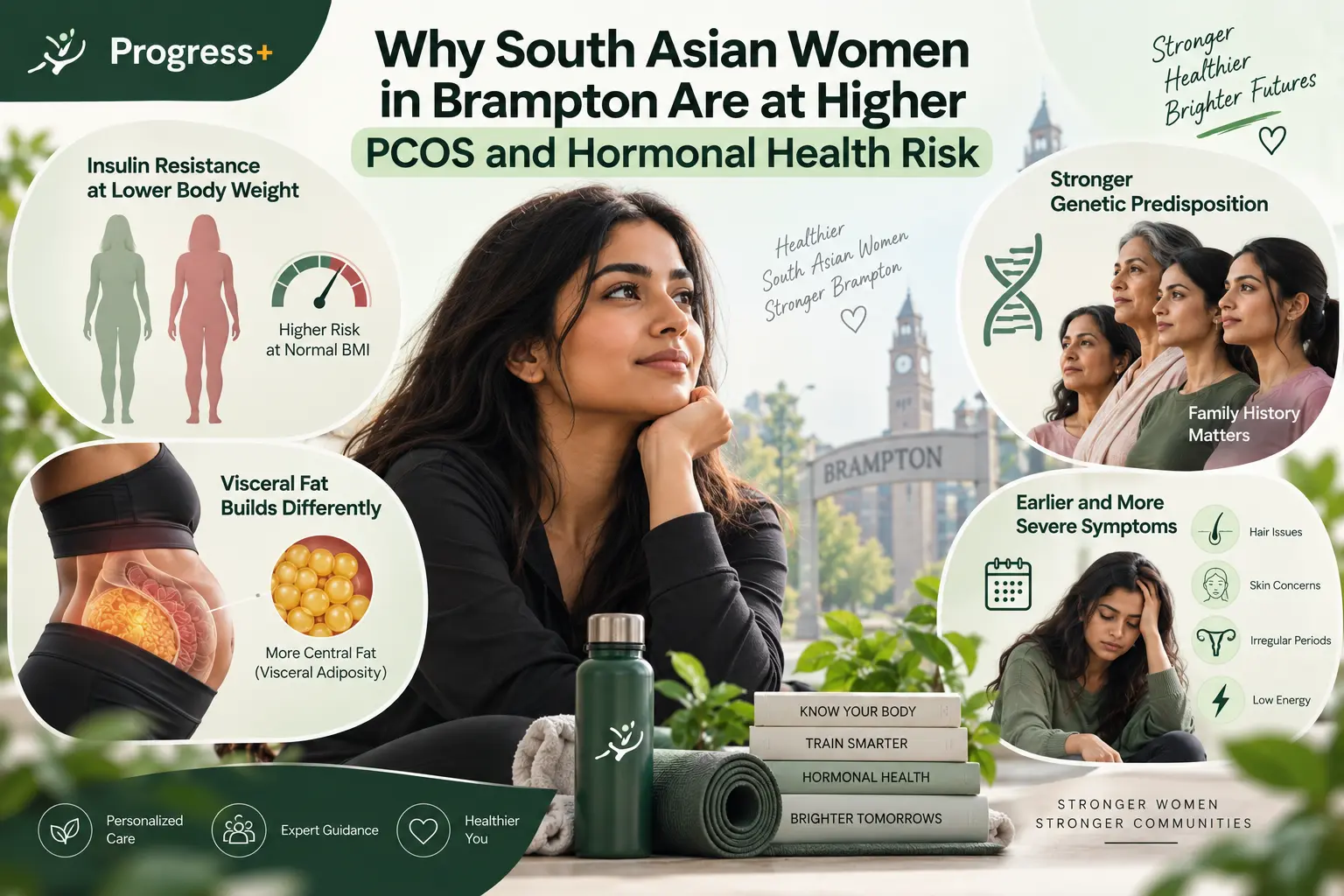
Why South Asian Women in Brampton Are at Higher PCOS and Hormonal Health Risk
This is the part that changes how the entire problem should be approached, so it's worth sitting with.
Insulin resistance shows up at a lower body weight.
Research on South Asian populations consistently shows that insulin resistance develops at BMI levels considered perfectly normal by general population health guidelines. This means two women can have the same weight and the same BMI, and one of them is already dealing with significant insulin resistance while the other isn't. Standard fitness and diet advice, built around general population BMI cutoffs, simply doesn't account for this.
Visceral fat builds differently.
Even at a healthy-looking weight, South Asian women tend to carry more fat around the organs (visceral or central adiposity) rather than under the skin. This type of fat is metabolically active and drives inflammation and insulin resistance in a way that's not always visible from the outside. This isn't a subjective observation, it's a pattern that's been documented across South Asian populations specifically, independent of general population norms.
There's a stronger genetic thread.
Family clustering and genetic predisposition to metabolic syndrome are more pronounced in South Asian populations. If your mother, aunts, or sisters have dealt with PCOS, thyroid issues, or type 2 diabetes, that's not a coincidence, and it's useful information for how your own program should be built.
Symptoms tend to show up earlier and more severely.
None of this is meant to sound clinical for its own sake. It's the reason Progress+ programs for South Asian women in Brampton are designed by Registered Kinesiologists with this population-specific research built into the programming itself.
It's Not Just PCOS — The Full Hormonal Picture
PCOS tends to get treated as its own isolated box, but in real life it rarely shows up alone.
Thyroid function and PCOS often overlap.
It's common for South Asian women managing PCOS to also be dealing with an underactive thyroid, and the two conditions can mask or worsen each other. Fatigue, weight changes, and mood shifts that get chalked up entirely to PCOS sometimes have a thyroid component that hasn't been fully addressed.
Cortisol and stress load matter more than most programs account for.
A lot of South Asian women in Brampton are carrying a caregiving load that doesn't show up in a typical intake form. Chronic stress keeps cortisol elevated, and elevated cortisol actively works against insulin sensitivity and hormonal balance.
The hormones themselves are worth understanding.
Estrogen, progesterone, testosterone, DHEA, and sex hormone-binding globulin (SHBG) all interact with each other. PCOS commonly involves elevated androgens and disrupted ovulation, but a full hormone panel often tells a more layered story that includes cortisol and thyroid markers alongside the reproductive hormones.
If you've cut carbs, tried keto, tried intermittent fasting, or eliminated dairy and gluten and still feel stuck, it's not because you lack discipline. It's because the advice itself wasn't built with your life in mind.
The South Asian diet itself isn't the problem. Rice, roti, and ghee, cooked and portioned thoughtfully, are not inherently at odds with hormonal health. The problem is usually a mismatch between generic diet advice and the reality of how South Asian households actually eat, especially around festivals and family gatherings. Diwali, Navratri, and similar occasions bring shifts in eating patterns that most diet plans simply don't build room for.
Fasting periods, including Ramadan, present a similar mismatch. A program that assumes continuous eating windows and then falls apart the moment fasting begins isn't a program built for real life.
And one of the more counterintuitive issues: a lot of the advice commonly given for PCOS pushes toward under-eating. In practice, chronic underfueling raises cortisol and worsens insulin resistance, which can make PCOS symptoms worse, not better.
This is exactly why nutrition guidance at Progress+ isn't handed over as a generic template detached from how you actually live.
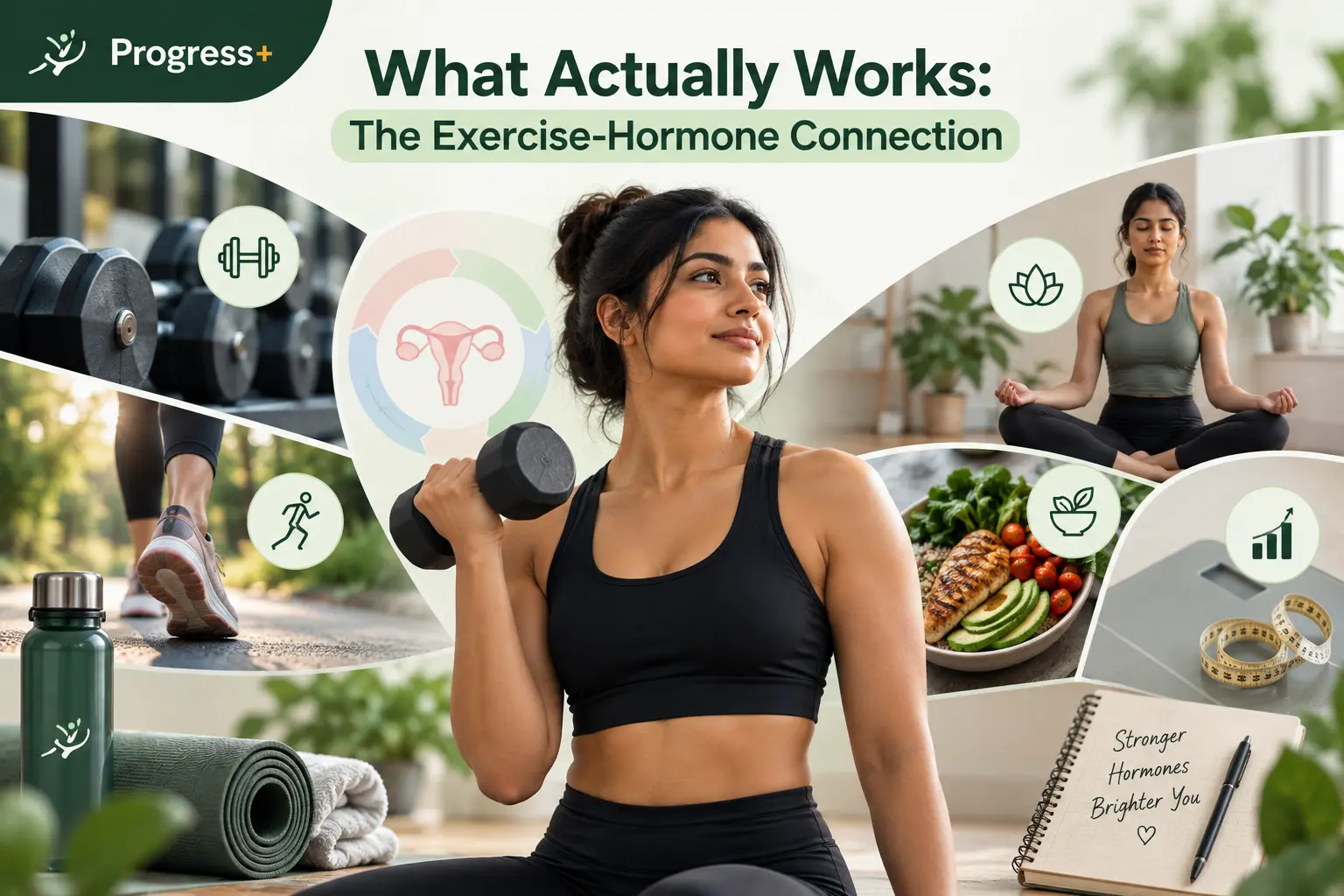
What Actually Works: The Exercise-Hormone Connection
Resistance training moves the needle on insulin sensitivity, and it moves fast. Consistent strength training with genuine progressive overload starts improving how your body responds to insulin within days, not weeks or months of waiting to see results.
Zone-2 cardio pulls its own weight on the cardiovascular front. Around 30 to 45 minutes of steady, moderate-intensity cardio a couple of times a week protects heart health and complements the strength work. Given that South Asian women already face higher cardiovascular risk alongside PCOS, this isn't something to skip if time feels tight.
Training with your cycle, not against it, changes everything. Your energy, strength, and ability to recover shift throughout the month, and a program that actually accounts for that holds up far better over time.
Mobility work is doing more than it looks like it's doing. Movement and breathwork built into each session help calm the nervous system.
Progress shows up in your body composition long before it shows up on a scale. Losing visceral fat and gaining lean muscle can happen while your weight stays nearly the same.
What a Naturopath Gives You vs. What Training Adds
A lot of women in Brampton have already been through the naturopathic route. Where it often stops short is in prescribing and supervising the exercise piece, which is where a lot of the day-to-day physiological change actually happens.
Naturopathic Treatment
R.Kin-Supervised Training
Primary focus
Hormone testing, supplements, herbal remedies
Structured, progressive exercise prescription
Addresses insulin resistance
Indirectly, through diet and supplementation
Directly, through resistance training
Clinical credential
Naturopathic Doctor
Registered Kinesiologist (COKO)
Ongoing accountability
Periodic consults
Regular sessions with progression tracking
Physician coordination
Sometimes involved
Required for condition-support programming
These two approaches aren't in competition with each other, and the strongest results usually come from combining both, ideally with your physician looped in on the full picture.
Building a Program Around Real Brampton Life
Training at home removes that friction entirely. For a lot of South Asian women, the idea of working out in a public gym adds a layer of self-consciousness that gets in the way before the workout even starts.
Real schedules get respected. Joint family living, caregiving responsibilities for parents or in-laws, and long commutes all shape when and how a session can actually happen.
Wedding season shouldn't be the only motivator. Hormonal health training should be about how your body actually functions, not a countdown to a single occasion.
There may be a financial angle worth asking your accountant about. Depending on your circumstances, sessions delivered by a Registered Kinesiologist may have insurance or medical expense tax credit implications.
What to Avoid
Excessive high-intensity training without recovery.
Pushing hard every session without adequate recovery keeps cortisol elevated and can work against the hormonal balance you're trying to restore.
Cardio-only programming.
Cardio alone burns calories but doesn't meaningfully address the insulin resistance driving most PCOS symptoms.
Unsupervised group classes with no clinical context.
Group fitness can be motivating, but without any understanding of your specific hormonal presentation, there's no real progression or adjustment happening.
Extreme calorie restriction.
Chronic underfueling tends to backfire by raising cortisol and worsening insulin resistance rather than improving it.
Frequently Asked Questions
What is the difference between PCOS and PCOD?
PCOS (Polycystic Ovary Syndrome) and PCOD (Polycystic Ovarian Disease) are often used interchangeably, though PCOD is a term more commonly used in South Asia and generally describes a milder presentation. Both involve hormonal imbalance and disrupted ovulation, and both respond to the same core interventions: structured exercise, sleep, stress management, and nutrition.
Why do South Asian women get PCOS at a lower body weight?
South Asian women tend to develop insulin resistance and carry visceral fat at lower BMI levels than the general population, along with a stronger genetic predisposition to metabolic syndrome. This means hormonal symptoms can appear even when weight looks 'normal' by standard guidelines.
Can exercise fix hormonal imbalance without medication?
Exercise, particularly resistance training, is one of the most well-supported non-medical interventions for hormonal imbalance and PCOS, and can meaningfully improve insulin sensitivity, cycle regularity, and symptom severity. It isn't a replacement for medical care and should be done alongside, not instead of, guidance from your physician.
Is a personal trainer or a naturopath better for PCOS?
They serve different purposes rather than competing with each other. A naturopath can help identify what's hormonally out of balance through testing, while a Registered Kinesiologist prescribes and supervises the structured exercise that directly improves insulin sensitivity. Most women see the best results using both, with their physician kept in the loop.
Do you have Punjabi- or Gujarati-speaking trainers in Brampton?
Yes. Many Progress+ trainers are fluent in Punjabi, Gujarati, Hindi, or Urdu, which makes it easier to talk through symptoms and daily life without a language barrier getting in the way.
Is PCOS training covered by insurance or eligible for a tax credit?
It depends on your individual insurance plan and tax situation. Sessions delivered by a Registered Kinesiologist may have insurance or medical expense tax credit relevance in some cases, but the Canada Revenue Agency generally excludes general fitness expenses. It's worth confirming your specific situation with your accountant.
How is hormonal health training different from a regular workout plan?
A regular workout plan is usually built around general fitness goals. Hormonal health training is built around your specific hormonal presentation, cycle patterns, stress load, and any comorbidities like thyroid dysfunction, with intensity and programming adjusted accordingly rather than following a fixed template.
Getting Started — Your Hormonal Health Program in Brampton
If you've spent months or years being told to eat less and move more without anyone explaining why that hasn't worked for your body, it's not you. It's that the advice wasn't built for the biology you're actually working with.
A Registered Kinesiologist-supervised program starts with understanding your specific hormonal picture, insulin resistance, cycle patterns, stress load, and anything else in the mix, and builds a plan around it, delivered in the privacy of your own home, in a language you're comfortable in, on a schedule that fits your actual life.
Progress+ programs are delivered by Registered Kinesiologists licensed by the College of Kinesiologists of Ontario. R.Kins provide structured exercise support and do not diagnose or treat medical conditions. Condition-support programming is delivered in coordination with your physician, and physician clearance is required before beginning. Always consult your doctor before starting a new exercise program.
About the Author
Every program at Progress+ is designed and delivered by Registered Kinesiologists licensed by the College of Kinesiologists of Ontario. The team brings hands-on experience training South Asian women across Brampton, Mississauga, and the wider GTA, with programming built around real hormonal and metabolic presentations rather than generic fitness templates.
Many of our trainers are fluent in Punjabi, Gujarati, Hindi, and Urdu, and all programming is delivered in coordination with each client's physician, particularly for condition-support programs like PCOS, hormonal health, postnatal recovery, and menopause training.
Progress+ was founded by Kartik Thakkar, who leads programming standards and brand direction, with every session ultimately delivered by a licensed R.Kin, not a generalist trainer applying a one-size-fits-all plan.
Conclusion
If there's one thing worth taking away from all of this, it's that your body isn't malfunctioning, and you haven't been failing at something everyone else finds easy. South Asian women develop insulin resistance earlier, at lower body weights, and with more genetic and hormonal complexity than most PCOS content ever accounts for.
None of this means you're stuck. Resistance training, cycle-aware programming, and a plan that actually works with your life can meaningfully change how your body responds, often faster than expected.
Book a complimentary assessment with a Registered Kinesiologist. No pressure, no sales script, just an honest look at your body and a plan built specifically for it.