Summary
Falls are common in older adults, but the right exercises can lower the risk. This guide includes simple moves that take less than 5 minutes and have a real impact. They start easy and get harder slowly, so strength builds a little at a time. You will also get a plain look at your options in Markham. Those options include free classes, OHIP funded physiotherapy, and in home training with a Registered Kinesiologist.
Key takeaways
- Exercise works. A large Cochrane review found that exercise lowers the rate of falls by 23 percent in people over 60 who live in the community.
- Combining exercise types works even better. Programs that mix strength and balance work cut the rate of falls by about 34 percent in the same review.
- Test yourself first. Three quick tests show where you stand today and give you a starting point to improve from.
- The sit to stand exercise is the best place to start. It builds the leg strength you use to get up from a toilet seat, a chair or a car seat.
- Safety comes first. Talk to your doctor first, keep a countertop within reach, and stop if something feels wrong.
- Markham has free and private options. You can pick one, or use both.
Introduction
Maybe your dad stopped using the basement stairs. Maybe your mom skips her Saturday walk because the sidewalk looks icy. Nobody calls it a fear of falling. People just quietly do less.
That quiet change matters. When seniors move less, their muscles weaken and the risk of falling goes up. The good news is that balance and strength exercises can reverse that.
This guide follows the Canadian guidelines and draws on published, authoritative sources, so seniors in Markham can get stronger and stay safe at home with their families.
The clear answer
The best fall prevention exercises for Markham seniors are the ones done in a planned way, starting easy and getting harder as strength grows. Talk to your doctor first, make your home safer, and keep a countertop or sturdy support within reach while you exercise. If you want guidance, you can book a Registered Kinesiologist to train you at home, or join a free community class.
Why falls matter more than most people think
At least one third of people over 65 who live in the community fall each year. Falls in older adults hurt in two ways.
First, the injury. In a national Canadian analysis, fractures made up 37 percent of fall injuries among seniors, and over 70 percent of seniors who sought treatment went to an emergency department. Canadian hospitals outside Quebec recorded 81,599 fall related hospitalizations of older adults in 2023 to 2024. Fall injuries like these can cost a senior their independence.
Second, fear. Many people stop taking part in activities because they are afraid of falling, and that fear can lead to depression and lost confidence. Many people also hide their falls. The CDC reports that more than half of older adults keep their falls secret from their doctors. If you or a parent has fallen, tell the doctor.
Here is the hopeful part. If 1,000 people were followed for a year and had 850 falls, exercise would result in 195 fewer falls. That is a real difference in real homes, and Markham's icy winters make it worth chasing.
What raises the risk of falling in older adults
Falls rarely have one cause. Several small things stack up. Learn the common fall risk factors so you can spot them early.
- Balance and walking problems. Shuffling, wide steps or holding walls all count.
- Vision changes. Poor eyesight hides a loose rug or an uneven step.
- Vestibular problems. The inner ear helps you stay steady, and problems there cause dizziness.
- Altered sensation in the feet. Numb feet cannot feel uneven ground.
- Multiple medications. Taking five or more medicines raises the chance of dizziness or drowsiness. Ask your pharmacist for a review, and never change a medicine on your own.
- Orthostatic hypotension. This is the lightheaded feeling you get when you stand up, and it is the term doctors use for a drop in blood pressure on standing.
- Feet and footwear issues. Worn soles, loose slippers and painful feet all matter.
- Home hazards. Dim lighting, loose rugs, cords and cluttered paths create trip hazards.
- Weak legs, low bone density and frailty risk. Weak muscles cannot protect thin bones, so a small slip can cause a fracture.
The strongest risk factor you can change on your own is leg strength, and that is where exercise comes in.
Check your risk of falling at home, three quick tests
Do these next to a countertop, with another person nearby. They come from the CDC's STEADI program. A low score does not mean you will fall. It tells you where to focus.
Timed Up and Go
Sit in a chair, stand up, walk about 10 feet at your normal pace, turn, walk back and sit down. A time of 12 seconds or more points to higher risk.
30 second chair stand
Sit in the middle of a straight backed chair with your arms crossed over your chest. Stand all the way up and sit back down as many times as you can in 30 seconds. If you must use your arms to stand, stop and record zero. A score below these numbers suggests higher risk.
| Age | Men (below) | Women (below) |
|---|---|---|
| 65 to 69 | 12 | 11 |
| 70 to 74 | 12 | 10 |
| 75 to 79 | 11 | 10 |
| 80 to 84 | 10 | 9 |
Four stage balance test
Try to hold each position for 10 seconds without support, feet side by side, one foot slightly ahead, one foot directly in front of the other, then one foot lifted. Being unable to hold the full heel to toe position for 10 seconds points to higher risk.
Write down your results, repeat the tests every few weeks, and show them to your doctor. If you see no improvement, consider the supervised options in this guide.
The sit to stand exercise, your best starting point
One of the best and easiest exercises for older adults is the sit to stand. It builds leg strength and improves the leg mechanics you use for everyday tasks.
Set up. Use a sturdy chair with no wheels and a backrest, and place it against a wall so it cannot slide. Put a countertop in front of you as a support surface. Sit with your feet flat and shoulder width apart.
How to do it. Scoot to the front of the seat. Lean your chest forward so your nose sits over your toes. Squeeze your gluteal muscles and rise slowly to a stable standing position. Pause for a moment, then lower yourself back down with control. Do not drop into the chair.
Level 1
Use your hands on the countertop for help. If standing is hard, add a firm cushion to raise the seat.
Level 2
Cross your arms over your chest and use only your legs.
Level 3, the advanced version
Hold light hand weights, or pause for three seconds at the bottom of each repetition. You can also gradually decrease reliance on the chair by touching the seat lightly instead of sitting down fully.
How much. Many beginners start with five to eight repetitions, rest, then repeat once. Add repetitions slowly. Ask your Registered Kinesiologist to confirm the right amount for your body.
Balance exercises, feet apart, feet together, one foot and eyes closed
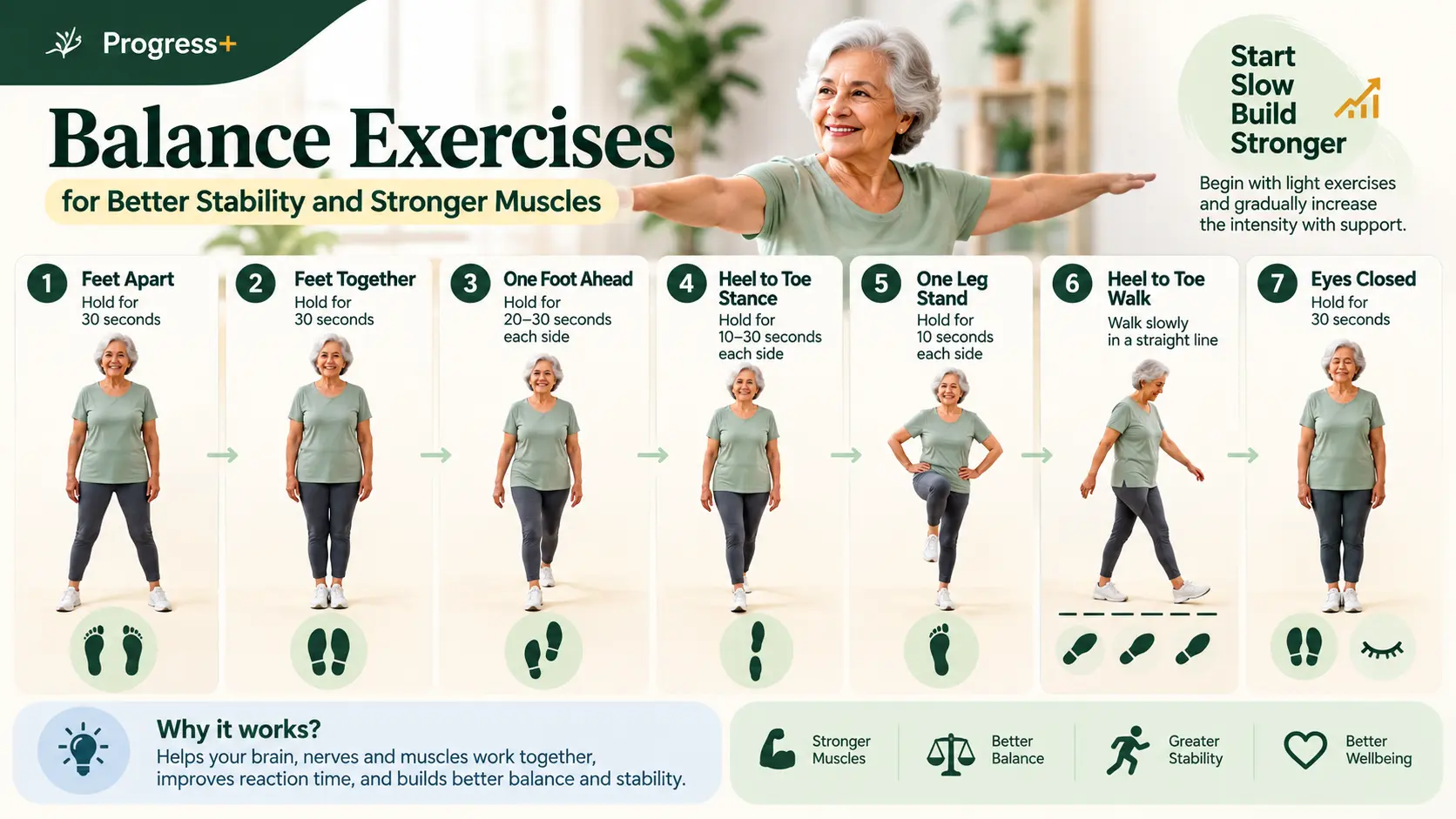
When you start balance exercises, don't begin with heavy challenges. Start with light, supported steps and raise the difficulty slowly, and your balance will improve.
- Feet apart. Stand with your feet shoulder width apart and hold for 30 seconds. Try for minimal swaying.
- Feet together. Bring your feet side by side and hold for 30 seconds.
- One foot slightly ahead. Place one foot a half step forward and hold for 20 to 30 seconds. Switch feet.
- Heel to toe stance. Put one foot directly in front of the other, like a tightrope. Hold for 10 to 30 seconds. Switch feet.
- One legged stand. Lift one foot a few centimetres off the floor and hold for 10 seconds. This is the single leg stand. Switch sides.
- Heel to toe walk. Walk along a counter or hallway with each heel touching the toes of the other foot.
- Eyes closed. Return to the feet together position and close your eyes. Your brain now has to rely on your feet and your inner ear alone. Try this last, with the countertop in front of you and a person standing beside you.
Why does balance practice work? Because it trains your brain and nervous system to connect with your muscles more strongly, which speeds up your reaction time and improves balance and stability for long term well being.
More exercises to build leg strength and stay steady
Add these once the sit to stand feels comfortable. Each one trains a muscle group that keeps you upright.
Standing exercises
- Calf raises. Hold a counter and rise onto your tiptoes, hold for three seconds, then lower your heels. This is calf muscle strengthening.
- Side leg raises. Lift one leg out to the side, keeping your toes forward. This trains the outer hips and thighs.
- Back leg raises. Lift one leg straight behind you without leaning forward. This works your glutes and lower back.
- Gentle weight shifting. Stand with your feet hip width apart and slowly move your weight from one foot to the other.
- Marching in place. Lift your knees slowly. It makes a good warm up and a gentle cardio booster.
- Wall push ups. Face a wall, stand an arm's length away and press your chest toward it and back. They build upper body strength, which helps you push up from a chair or catch yourself.
Seated exercises for unsteady days
- Flex and point. Lift your toes toward your shins, then point them down.
- Toe taps. Tap your toes up and down. This is shin muscle strengthening.
- Ankle flexes and circles. Draw slow circles with each foot. They support ankle mobility.
- Seated leg lifts. Straighten one knee and lift your leg a few seconds, then lower.
Weight bearing exercises like these also support bone density, and stronger bones lower the chance of a fracture if you do fall. If you have osteoporosis, ask your doctor and your Registered Kinesiologist which versions suit you. Our Bone Density & Osteoporosis program covers this area in depth.
A simple weekly plan
You do not need a gym. The Canadian 24 Hour Movement Guidelines for adults 65 and older call for at least 150 minutes a week of moderate to vigorous activity, muscle strengthening at least twice a week, and activities that challenge balance. ParticipACTION's report card says only 31 percent of adults 65 and older meet the balance part of that guideline. You can beat that number.
A starting plan that follows the guideline.
- Balance practice, 5 to 10 minutes on most days. Work on your current step of the ladder.
- Strength, two or three days, with a rest day between. Do the sit to stand exercise, calf raises, side leg raises, back leg raises and wall push ups. One to two sets of 8 to 10 repetitions is a sensible start.
- Walking, build toward 150 minutes across the week. Short walks of 10 minutes count.
- Warm up, march in place for two to three minutes before you begin.
How many times a day should seniors do balance exercises? Once or twice a day in short sessions works well for most people. How often should seniors do fall prevention exercise? Strength work two or three days a week is a sensible start. Everyone's body is different, so if you feel unusual soreness, rest and ask a Registered Kinesiologist to adjust the plan.
Safety rules before you start
Talk to your doctor first. Do this without fail if you have a health condition or have been treated recently. People at lower risk can often start on their own, and people at higher risk should start under supervision.
Is it safe for elderly people to do balance exercises alone? For the early steps with a countertop in reach, many people can practice alone. Skip the one legged stand, the heel to toe walk and the eyes closed step unless someone is with you or a professional has cleared you. If you live alone, schedule practice when someone is home or check in by phone.
Stop and get help if you feel:
- chest pain or pressure
- sudden dizziness or lightheadedness
- new sharp pain, especially in a joint
- a sudden change in balance or vision
- trouble breathing
If you feel serious pain while exercising, stop. Ask a Registered Kinesiologist or a physiotherapist to show you a safer way to do the exercise. If you are exercising alone and have chest pain or severe pain, call 911 immediately.
Additional steps to prevent falls at home
Exercise gives your body skills. These steps remove the traps. They build safety at home and help you prevent future falls.
- Do a night walk test. Walk from your bed to the bathroom in the dark. Add motion sensor night lights anywhere you stumble. Dim lighting hides trip hazards.
- Check home for trip hazards. Remove loose rugs, tape down cords, and clear paths. Look at thresholds between rooms.
- Fix the bathroom. Grab bars, a nonslip mat and a raised toilet seat help many seniors.
- Light the stairs. Make sure handrails run the full length on both sides, and put a switch at the top and bottom.
- Check shoes. Choose supportive shoes with a firm sole and a snug heel, and skip loose slippers.
- Book a vision check. Do it once a year, and again after a new prescription.
- Review medicines. Ask a pharmacist or doctor whether any of yours cause dizziness or drowsiness.
- Stand up slowly. If you feel lightheaded, sit on the edge of the bed for a minute first. This helps with positional low blood pressure.
- Plan for winter. Keep gripping boots by the door, use ice melt on the front steps, make sure the handrail is solid, and ask a neighbour or family member to clear the entry. Take extra care at the garage step and the porch.
Some families add home modifications like a stair lift or a walk in shower. These help seniors who want to stay in their homes, which many call aging in place. Our Active Aging page explains how supervised training supports that goal. Think of exercise and a safer home as one plan, not two.
Rebuilding confidence after a scare
As people age, many develop a fear of falling because their bodies feel less strong. Practising these exercises can rebuild that confidence.
Start with the easiest step of each exercise, and keep a countertop within reach. Write down your wins, like holding a stance five seconds longer or finishing a walk you skipped last month. Practice at the same time every day so it becomes a habit. Ask a friend or family member to join you. Confidence grows faster with company.
Improved wellbeing comes along with the physical gains. Seniors who practice regularly often tell us they feel more willing to go out, visit family and take the stairs again. That is the real goal, staying active as you age, and avoiding injuries as you age.
Fall prevention options in Markham
Markham has more choices than most people realize. You can use one, or combine them.
Free exercise classes for seniors in Markham. Carefirst Seniors and Community Services Association runs falls prevention classes in Markham led by a physiotherapist or another regulated health care provider. The directory lists several sites.
The Kinatex Sports Physio site on 14th Avenue East runs Tuesday and Thursday mornings. Unionville Community Centre for Seniors, at Central United Church, runs falls prevention on Tuesday and Friday afternoons, and a yearly membership fee may apply. Armadale Community Centre runs a Monday class, and you must register with the City of Markham as well. Aaniin Community Centre offers classes on Monday mornings through the Social Services Network. Welcome Centre Markham South runs classes for newcomer seniors.
These classes are for adults 65 and older or people with mobility issues, and you apply through Ontario Health atHome at 1 888 470 2222. Some Carefirst programs run in both Cantonese and English. Schedules change, so call before you go. Markham also has City older adult clubs, and our guide on Exercise for Type 2 Diabetes and Prediabetes in Markham lists several of them.
Physiotherapy covered by OHIP. With a valid Ontario health card, you can get government funded physiotherapy at OHIP funded clinics if you are 65 or older. Physiotherapy suits you after a recent illness, injury or surgery, or when symptoms flare, and a registered physiotherapist assesses you one on one. It treats a problem. It does not replace a regular exercise habit.
In home training with a Registered Kinesiologist. Our In-Home Personal Trainer in Markham service sends a regulated professional to your living room. That suits seniors who feel unsteady, want one on one attention, or find travel hard. It also suits anyone who wants someone to watch their form and raise the difficulty at the right pace. This is professional fall prevention training for seniors that fits your own space. Our Fall Prevention & Balance program is built for this. Read the guide on Personal Trainer Markham Cost for pricing.
Which route fits you?
- If you feel steady, enjoy company and can travel, try a free class first.
- If you recently had surgery or an injury, ask your doctor about OHIP funded physiotherapy.
- If you feel unsteady, live alone, want privacy or dislike group settings, book a Registered Kinesiologist at home.
- If you want the best of both, join a class for the social side and add a few home sessions for personal coaching.
OHIP does not cover kinesiology services. Some extended health plans cover kinesiology, so ask your insurer. Sessions may be eligible for the Medical Expense Tax Credit in certain cases, so speak with your accountant to confirm your situation.
Why a Registered Kinesiologist for fall prevention
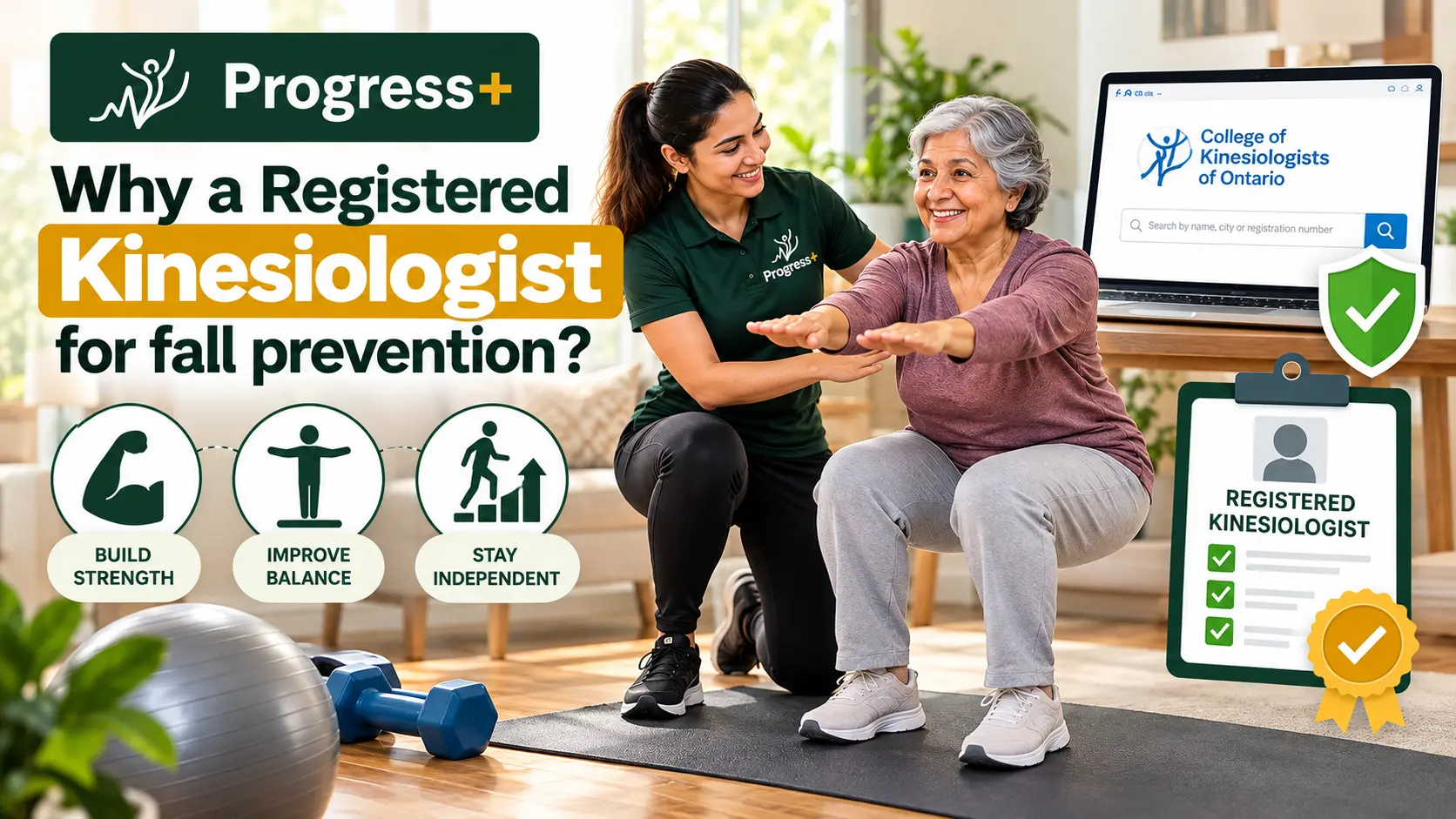
In Ontario, the title kinesiologist is protected, and only people registered with the College can use it. You can search the public register by name, city or registration number. Check any provider on the College of Kinesiologists of Ontario register before they enter your home.
Why do credentials matter for falls? The Cochrane review found a larger effect on falls when a health professional delivered the program. That review did not study kinesiologists specifically, but it supports the idea that qualified supervision helps. A Registered Kinesiologist tests your strength and balance, picks exercises that fit your health, raises the challenge safely and works with your doctor. In that sense, a Registered Kinesiologist can act as a fall prevention expert for seniors, someone who knows how to push progress without pushing too far. Curious about the difference from a regular trainer? Read Registered Kinesiologist vs Personal Trainer in Markham.
For families, how to help without hovering
If you are an adult child, you can help in small ways. Ask your parent to try the chair stand test with you. Walk the night path together and fix what you find. Offer to attend a class or a first session, so the change feels shared. Ask about falls and near falls gently, and encourage them to tell their doctor. Watch for warning signs, holding furniture, slowing on stairs, avoiding outings or complaining about weak legs.
Families who live far away can still help by arranging a first assessment and joining the review by phone. The aim is simple, keep the seniors you love safe, and keep them doing what they enjoy.
Frequently asked questions
How can older adults prevent falls?
What are the best balance exercises for seniors?
How many times a day should seniors do balance exercises?
Can exercise reduce the risk of falling?
Is it safe for elderly people to do balance exercises alone?
Why do older people fall?
Are there free fall prevention classes in Markham?
Does OHIP cover exercise with a kinesiologist?
What is the best way to test fall risk at home?
What should I do after a fall?
Conclusion
You do not need to do everything at once. Take the three tests this week. Practice the sit to stand exercise a few times a day. Climb one step of the balance ladder at a time. Walk the night path and fix what you find. Each small step builds leg strength, sharpens balance and lowers the risk of a serious injury.
Fall prevention is not about fear. It is about staying active, steady and independent in the place you call home. If you want a guide, Begin Your Program with a free assessment from a Registered Kinesiologist. You can also start with a free class in Markham. Either way, start this week.
This guide offers general information and exercise education. It is not medical advice. Talk to your doctor before you begin any new exercise program, especially if you have a health condition, take several medicines or have fallen recently.