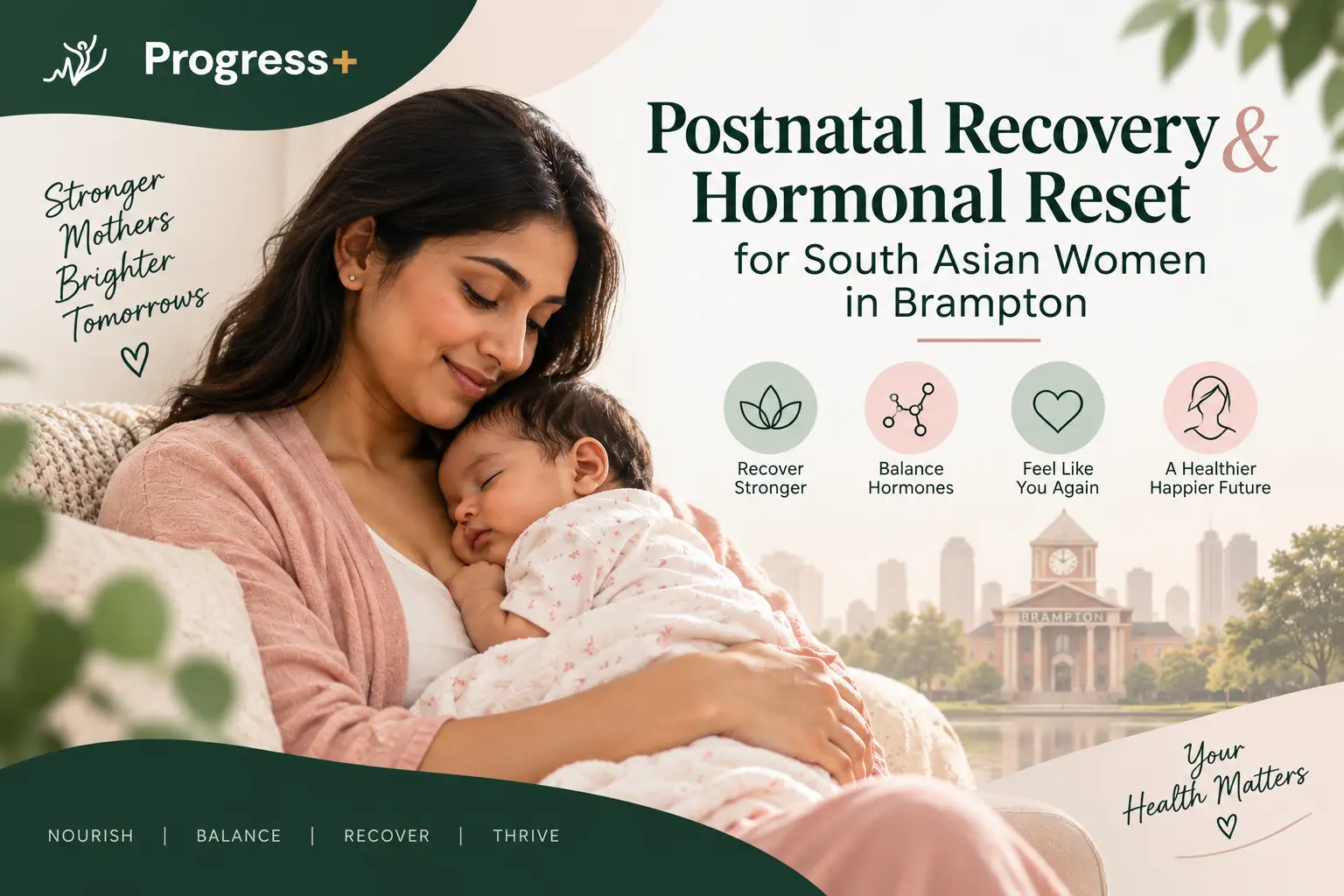
If you're reading this while your baby is finally asleep and you're stealing five minutes to yourself, we want to start by saying something simple: what you're going through right now is real, and it deserves more than the generic advice most postpartum content offers.
This piece covers a lot of ground on purpose. We talk about the actual hormonal changes happening in your body right now, the estrogen and progesterone drop, the relaxin still loosening your joints, and a condition called postpartum thyroiditis that rarely gets mentioned but genuinely should be. We look honestly at why South Asian women face a different metabolic reality after childbirth, backed by real research, not assumptions. We talk about honouring the jaappa period instead of rushing past it, and we lay out a staged, medically sound path for returning to movement once your body is actually ready. We also touch on something that's too often left unsaid in South Asian households: the emotional weight of this stage, and why it deserves real support, not silence.
None of this is written to alarm you or to sell you on doing more than you need to right now. It's written because we believe South Asian mothers in Brampton deserve postnatal guidance that actually understands them, culturally and medically, instead of a one-size-fits-all plan that ignores half of who they are. Take your time reading through it, and know that wherever you are in your recovery right now is exactly where you're supposed to be.
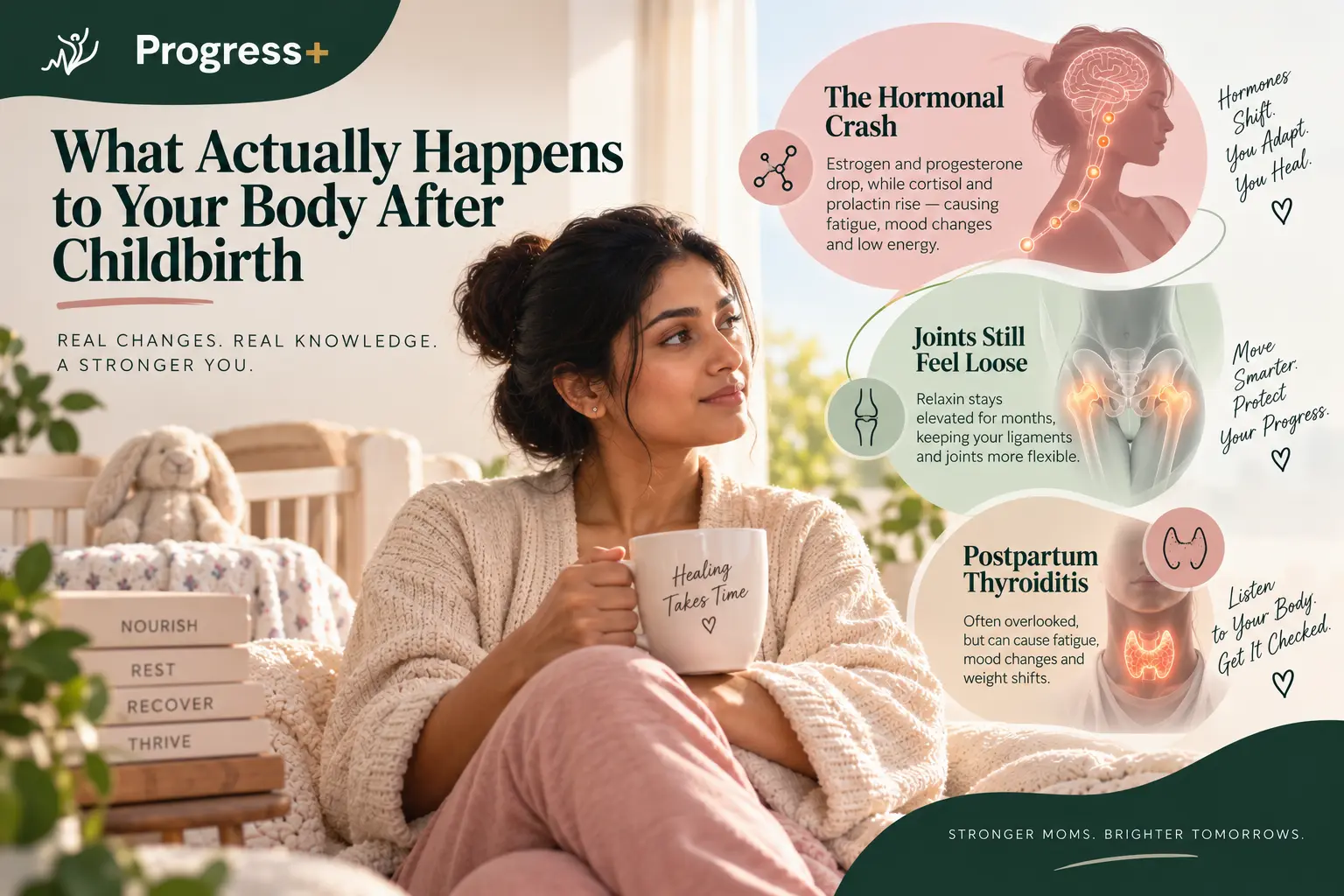
Your exhaustion and mood swings have a real, physical cause. The drop in estrogen and progesterone right after delivery, alongside rising cortisol and prolactin, is one of the most dramatic hormonal shifts your body will ever go through. What you're feeling isn't weakness. It's biology, and it takes real time to settle.
Relaxin can stay elevated for months, not weeks. This is why jumping back into your old workout routine too soon can actually work against you. Your joints and pelvic floor may still be finding their new baseline long after you start to feel ready.
Postpartum thyroiditis is real, and it's worth checking for. If your fatigue or mood feels heavier than it should, that's worth a real conversation with your doctor, not something to quietly write off as normal new-mom tiredness.
South Asian women face a genuinely different metabolic reality after childbirth. Research shows sharper drops in insulin sensitivity and different fat storage patterns compared to general population averages, which means standard weight benchmarks don't always tell the full story for you.
This isn't a diagnosis, it's context. The metabolic research we've shared is meant to inform, not alarm. Any real concerns about your personal risk belong in a conversation with your physician.
The jaappa period isn't outdated, it's wisdom worth honouring. The 40-day tradition of rest, warmth, and family care reflects something modern medicine now confirms: your body genuinely needs that time to heal before movement should begin.
Recovery works best in stages, not all at once. From medical clearance in the first six weeks, to careful reactivation, to rebuilding real strength beyond twelve weeks, your body deserves a plan that matches where it actually is, not an arbitrary timeline.
Your emotional wellbeing matters just as much as your physical recovery. Postpartum depression and anxiety are just as common in South Asian communities as anywhere else, even if it's talked about less. If something feels off, please say so, to your doctor and to the people supporting you.
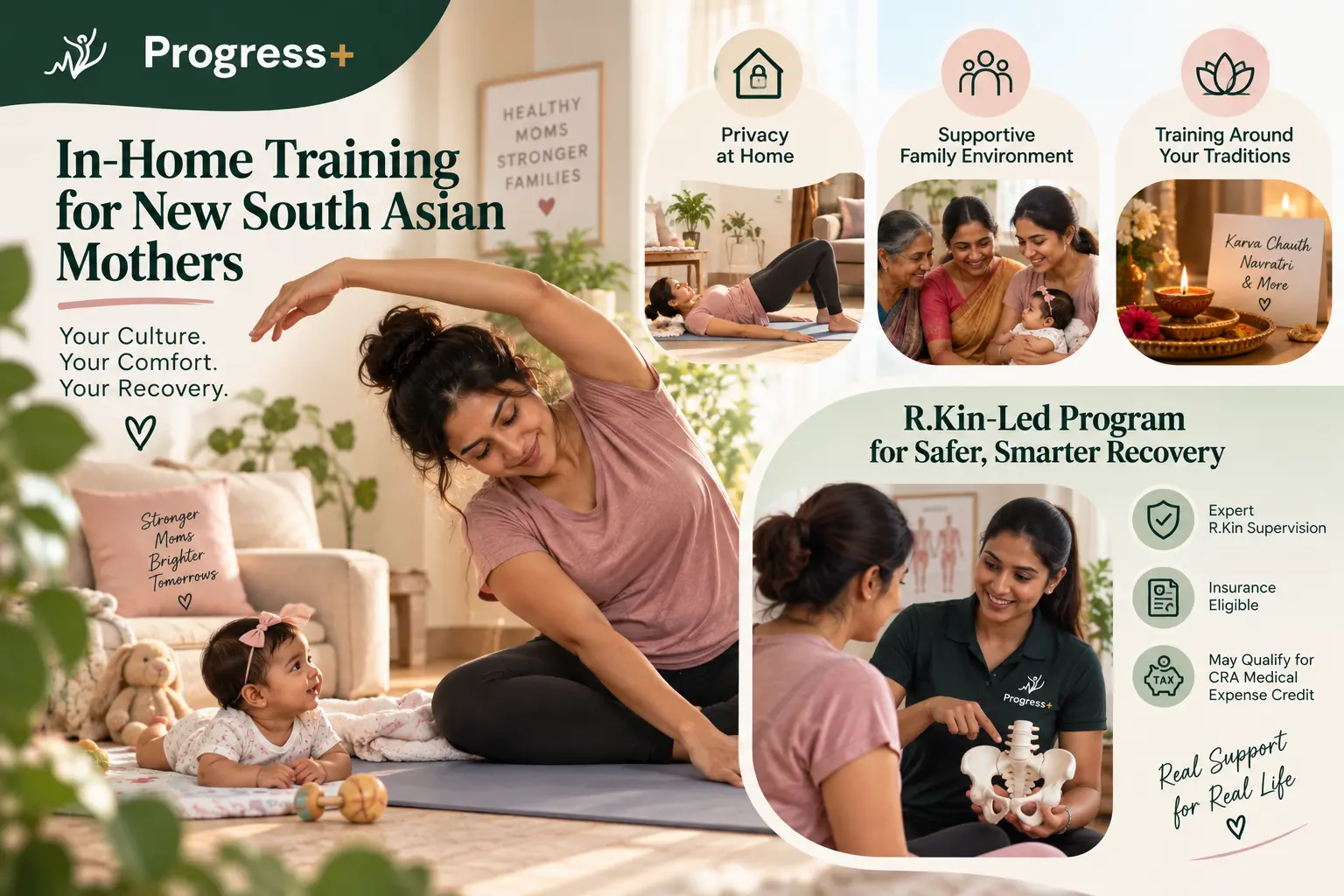
In-home, culturally aware training removes barriers that generic fitness plans ignore. Privacy within a joint family home, a trainer who speaks your language, and a plan that respects fasting and festivals shouldn't be a luxury. They should be the standard.
A Registered Kinesiologist brings a level of care general certification simply doesn't. From assessing pelvic floor and core concerns properly to potential insurance or tax credit eligibility, working with an R.Kin means your recovery is being guided by someone genuinely qualified to guide it.
Introduction
Most postpartum fitness advice out there is written for nobody in particular. It talks about getting your body back without ever acknowledging that your body, your family structure, and your recovery timeline might look completely different depending on where you come from. And on the other side, most of the South Asian postpartum wisdom passed down through generations focuses entirely on rest and food, with almost nothing about what comes after, when you're ready to actually move and rebuild strength again.
At Progress Plus, we sit right in the middle of that gap. Our Registered Kinesiologists (R.Kin) work with South Asian mothers across Brampton to build postnatal recovery and hormonal reset plans that take both sides seriously: the medical reality of what your body just went through, and the cultural reality of how you were raised to heal. You shouldn't have to choose between the two, and with the right guidance, you don't have to.
What Actually Happens to Your Body After Childbirth
Nobody hands you a manual for what your body goes through after delivery. Most new mothers are simply told to "give it time," without ever being told what that time is actually doing inside their bodies. Understanding those changes is the first real step toward postpartum recovery that actually works, instead of recovery based on guesswork.
The Hormonal Crash
Within hours of delivery, your estrogen and progesterone levels, which had spent nine months steadily climbing, drop off almost overnight. At the same time, cortisol and prolactin rise to help your body produce milk and cope with the sheer physical demand of caring for a newborn. This postpartum hormonal imbalance is one of the most dramatic shifts the human body goes through at any point in life, and honestly, it explains a lot more than most new mothers are ever told.
That exhaustion that doesn't lift, even after what should have been a decent stretch of sleep. The mood swings that seem to arrive out of nowhere, for no reason you can point to. The strange feeling of not quite recognizing your own body, even months into what's often called the fourth trimester. None of that means something is wrong with you, and it definitely doesn't mean you're not coping well enough. It's your body working through a hormone balance after childbirth that genuinely takes time to settle, no matter how strong or prepared you are.
We want to be honest about this because so few people are. What you're feeling has a real, physical explanation behind it, and it deserves to be treated that way, not brushed off as something you should already be over. Understanding this is often the first moment of relief for a lot of the mothers we work with, simply knowing that what they're going through is real, expected, and temporary.
Why Your Joints Still Feel Loose
During pregnancy, your body produces relaxin, a hormone that loosens your ligaments and joints to prepare for delivery. What most women are never told is that relaxin hormone postpartum doesn't simply switch off once the baby arrives. It can stay elevated in your system for months, not weeks.
This detail matters more than most people realize. It's a big reason why jumping straight back into your old workout routine, or following generic advice meant for someone who never went through childbirth, can actually work against you. Your joints and your pelvic floor may still be settling into a new baseline long after you start to feel physically capable. Training with that understanding isn't a limitation. It's what protects you from injuries that are completely avoidable with proper, trimester-specific programming and guidance from someone qualified to assess where you actually are.
Postpartum Thyroiditis: The Fatigue Nobody Screens For
Here's something that almost never comes up in postpartum conversations, even though it probably should. Postpartum thyroiditis is a real, medically documented form of thyroid dysfunction after pregnancy that can develop within the first year after delivery. It isn't rare, and it isn't something you imagined. It can bring on fatigue, mood changes, or unexplained weight shifts, and because those symptoms overlap so closely with what every new mother feels anyway, they often get waved off as just "normal new-mom tiredness." Nobody checks, because nobody thinks to ask.
We think that's worth naming honestly. If your exhaustion feels heavier than it should, given how much sleep you're actually getting, or if your energy and mood just aren't improving the way you'd expect them to as the weeks go by, that's a real signal, not something to push through quietly. It doesn't automatically mean something is seriously wrong. Most of the time, it simply means your body needs a closer look than "you're a new mom, of course you're tired" gives it credit for.
This is exactly the kind of thing we encourage every client to bring up with their doctor, and we mean that seriously, not as a formality. You know your own body better than any chart or checklist does. Trusting that instinct, and having someone actually listen when you raise it, is what real postnatal care is supposed to look like. That's the standard we hold ourselves to at Progress Plus, and it's the standard we think every new mother deserves.
Why South Asian Women Face a Different Metabolic Reality Postpartum
This is a part of the postpartum conversation that almost nobody is having, and it's one of the reasons we felt this piece needed to exist.
Elevated Metabolic Risk at a Lower Body Weight
A growing body of research on South Asian metabolic health points to something important: South Asian bodies often respond differently to weight changes than the general population averages most of us grew up hearing about. This means the standard BMI charts and weight benchmarks many of us were taught to measure ourselves against don't always tell the full story for South Asian women, especially after pregnancy.
What the Research Shows
Studies comparing South Asian and white European adults have found real ethnic differences in weight gain response. In controlled research, South Asian participants experienced a much sharper drop in insulin sensitivity after gaining the same amount of weight as their European counterparts. Part of the explanation appears to lie in adipocyte morphology, essentially how fat cells are structured and how the body stores fat. South Asian adults tend to store a higher proportion of visceral fat, the kind that sits around the organs, rather than under the skin, even at a similar overall weight.
We want to be upfront about what this is and isn't. This is general population research, not a diagnosis, and it isn't a reason for alarm. It's simply useful context. If you'd like to understand what any of this might mean for your own health, that's a conversation worth having with your physician, not something to self-diagnose from a blog post.
Why This Raises Real Postpartum Risk
This ethnicity and insulin sensitivity pattern is closely tied to a higher risk of gestational diabetes and, over time, type 2 diabetes. It also plays into postpartum weight retention, where the number on the scale might look unremarkable while the underlying metabolic risk is actually elevated. This is exactly why ethnic-specific fitness programming matters. A plan that accounts for this pattern, alongside where you actually are in your recovery, gives you a far more honest picture of your health than weight alone ever could.
Honouring the Jaappa Period Before You Return to Exercise
Long before postpartum fitness became a category on social media, South Asian families already had their own systems for helping new mothers heal, and there's real wisdom in them.
What the 40-Day Confinement Period Is Meant to Do
The jaappa period, sometimes referred to as the sutika postpartum tradition, typically spans the first 40 days after childbirth. It's built around rest, warmth, and being cared for by family, with the new mother stepping back from housework, cooking, and hosting guests. This isn't outdated thinking. These postpartum rest customs in South Asia reflect a genuine understanding that the body needs real time to heal, something modern medicine now backs up through what we know about hormone recovery and tissue repair after birth.
The Wisdom in the Desi Postpartum Diet
Traditional South Asian postpartum traditions often include a specific desi postpartum diet, warming, easily digestible foods rich in ghee, dals, and particular spices believed to support healing and milk supply. Whatever your own family's version of this looks like, the underlying principle holds up well: nourishment and rest come first, and structured movement comes later, once your body has had the chance to recover.
When It's Medically Appropriate to Transition to Movement
Tradition and modern recovery science don't have to compete with each other. In fact, they work best together. Once your confinement period ends and you've received medical clearance from your doctor, that's the natural point to bring in a structured plan that picks up exactly where your family's care leaves off, rather than undoing it.
From Confinement to Comeback: A Staged Recovery Framework
Rather than pushing you into a generic workout plan, real postnatal recovery works best as a staged process that matches where your body genuinely is at each point.
Weeks 0 to 6: Respecting Rest and Medical Clearance
This early window should be about healing, not training. Whether you had a safe exercise after C-section recovery ahead of you or a safe exercise after vaginal delivery timeline, your body is repairing tissue, adjusting hormones, and recovering from significant physical demand. Medical clearance postpartum exercise, usually confirmed around your six-week checkup, is the first checkpoint before any structured training begins. This is non-negotiable, and any trainer who tells you otherwise isn't someone you should be working with.
Weeks 6 to 12: Safe Reactivation
Once you're cleared, this is where careful, low-impact postpartum exercise safety work begins. This stage centers on core rehabilitation postpartum, checking for and addressing diastasis recti, the separation of your abdominal muscles that's extremely common after pregnancy, and rebuilding pelvic floor dysfunction concerns through targeted postpartum core and pelvic floor training. A Registered Kinesiologist assesses you individually here, with proper symptom monitoring postpartum training throughout, rather than assuming every new mother is starting from the same place. Where something falls outside our scope, we'll refer you to a pelvic floor physiotherapist referral without hesitation.
12 Weeks and Beyond: Rebuilding Strength and Resetting Hormonal Balance
This is where a real postpartum strength training plan takes shape. With your core and pelvic floor foundation established, training shifts toward rebuilding overall strength, restoring postpartum core strength, and supporting your body through hormonal reset. Progress here is guided by gradual return to training principles and how your body actually responds, never by an arbitrary timeline or pressure to feel "back to normal" faster than your body is ready for.
The Emotional Side of Postpartum Recovery in South Asian Households
Physical recovery is only part of the picture, and this part deserves honesty rather than silence.
Why Postpartum Mood Changes Are Underdiscussed in South Asian Families
How the Right Support System Can Help, Alongside Medical Care
If you're feeling persistently low, anxious, or like you've become disconnected from yourself in the weeks or months after birth, please don't sit with that quietly. It's worth raising with your doctor, and it's worth raising sooner rather than later. What you're feeling matters, and it deserves real attention, not just reassurance that it will pass.
This is also where the right kind of support can genuinely help. Structured, encouraging training can be a meaningful part of your emotional wellbeing after childbirth, but it's meant to work alongside physician-coordinated care, never in place of it. We're careful about that distinction because it matters. We're not here to diagnose or treat mental health conditions, and we'll always point you toward your doctor when something feels bigger than what movement alone can address.
What we can offer is consistency. A postpartum support system where someone actually notices how you're doing, checks in on more than just reps and sets, and takes it seriously when you say something feels off. For a lot of the mothers we work with, having that steady, attentive presence during one of the hardest transitions of their life makes a real difference, not as a substitute for medical care, but as one more layer of support that says you're not going through this alone.
What Makes In-Home Training Different for New South Asian Mothers
Recovery doesn't happen in isolation from your home life, and for many South Asian women, home life comes with its own real considerations.
Privacy, Joint Family Living, and Training on Your Own Schedule
Many South Asian households include extended family, and heading to a public gym isn't always practical or comfortable in the early postpartum stage. Privacy in-home training means you can work on your recovery in a familiar, private space, on a schedule that fits around your baby rather than a gym's opening hours. This kind of joint family postpartum support built into how we train isn't an afterthought for us. It's central to how in-home postnatal training should work in the first place.
Language-Matched, Culturally Aware Trainers
Working with a language-matched trainer who genuinely understands your cultural context removes a layer of explaining that shouldn't be necessary to begin with. You shouldn't have to define what jaappa means or justify why your mother-in-law has strong opinions about when you should start exercising. A trainer who already understands this can spend that time focused on your actual recovery instead.
Working Around Festivals and Fasting Periods Safely
Postpartum recovery doesn't pause for Karva Chauth or Navratri fasting, and your training plan shouldn't ignore that reality either. Adjusting intensity and timing around festival and fasting postpartum periods, instead of expecting you to push through them, respects both your body and the traditions that matter to you.
Why an R.Kin-Led Program Matters for Postnatal Clients
Not all fitness credentials are equal, and postpartum recovery is exactly the kind of specialized territory where that difference shows.
What Registered Kinesiologist Supervision Adds
A Registered Kinesiologist is regulated by the College of Kinesiologists of Ontario and trained specifically to assess and program around injury, medical conditions, and physical dysfunction, not just general fitness goals. Postnatal fitness certification alone doesn't cover this depth. For clients navigating diastasis recti, pelvic floor concerns, or the ethnic-specific metabolic factors we've talked about here, that level of training genuinely changes both safety and results. This is what a Registered Kinesiologist in Brampton brings to your recovery that a standard personal trainer simply isn't trained to provide.
Insurance Eligibility and the CRA Medical Expense Tax Credit
Because our trainers are Registered Kinesiologists, sessions may qualify as insurance eligible personal training, and in some cases may count toward the CRA Medical Expense Tax Credit. Eligibility depends entirely on your specific insurance plan and personal tax situation, so we always recommend confirming the details with your insurance provider or accountant before assuming coverage applies to you.
Getting Started With Postnatal Recovery in Brampton
If you're a new mother in Brampton trying to navigate the space between honouring your recovery and wanting to feel strong again, you don't have to figure it out alone, and you don't have to choose between tradition and progress. Progress Plus works with South Asian fitness clients across Brampton to build postpartum personal trainer Brampton plans that respect where you come from and where your body actually is right now, led by professionals who understand both the science and the culture behind your recovery.
When can I safely start exercising after childbirth?
Usually after medical clearance from your doctor, around six weeks, then gradually from there based on how your body responds, not a fixed timeline.
Do I need to follow the jaappa period before training again?
It's not required, but it's worth respecting. The 40-day rest period gives your body real time to heal, and it's a good foundation to build on once you're ready to move again.
Why does my metabolism feel different after having a baby?
Research shows South Asian women often experience different insulin and fat-storage patterns than general population averages. It's not a diagnosis, just something worth discussing with your doctor if you're concerned.
Is it normal to still feel emotionally off months postpartum?
Yes, and it's more common than most South Asian families talk about. If it persists, please raise it with your doctor rather than staying quiet about it.
What makes a Registered Kinesiologist different from a regular trainer?
An R.Kin is regulated and trained to work with injuries and conditions like diastasis recti or pelvic floor issues, offering a level of safety general certifications don't cover.
Can training work around joint family living or fasting periods?
Yes. We build sessions around your privacy, language, and schedule, including adjusting for fasting periods like Karva Chauth or Navratri.
About the Author
This piece was put together by Kartik Thakkar, working closely with the Registered Kinesiologist team at Progress Plus. Kartik has spent real time researching postpartum health specifically through a South Asian lens, because so much of what's written on this topic either ignores the culture or ignores the science, and new mothers deserve better than having to choose between the two.
Every clinical detail here, from the hormonal changes to the metabolic research, has been reviewed alongside our R.Kin team to make sure it holds up, not just written to fill a page. Progress Plus works with South Asian mothers across Brampton and the wider GTA every week, so none of this is theoretical for us. It comes from real conversations with real moms navigating the same jaappa traditions, the same family expectations, and the same questions about when and how to safely start moving again.
If something here feels familiar to what you're going through, we'd genuinely encourage you to reach out, whether that's to us for a consultation, or to your doctor for anything that feels bigger than what a blog post can address. Either way, that's the right next step.
Conclusion
If there's one thing we want you to take from all of this, it's that your recovery deserves more thought than "just give it time." Postnatal recovery for South Asian women isn't a single, simple process. It's a real hormonal reset shaped by genuine physiological change, a metabolic reality that looks different for you than it does for the general population, and a set of cultural traditions that, when honoured instead of brushed aside, actually make your recovery stronger, not slower.
You don't have to pick between respecting where you come from and moving forward with your health. The jaappa period your family observed, the rest your mother or mother-in-law insisted on, the food that was cooked for you in those first weeks, none of that has to be left behind the moment you're ready to start training again. A good recovery plan builds on that foundation instead of ignoring it.
This is exactly what we try to do at Progress Plus, every single day, with every mother we work with. Our Registered Kinesiologists take the time to understand both the science of what your body has been through and the culture that shaped how you were cared for after birth. That combination isn't something you'll find in a generic postpartum program, and honestly, we don't think it should be optional. It should be the standard every new mother in Brampton has access to.
If anything in this piece felt like it was speaking directly to you, that's not a coincidence. It's because it was written for you. And if you're ready to take the next step in your recovery, whether that's a conversation with your doctor or a conversation with us, we'd be glad to be part of that journey with you. Book your free assessment whenever you're ready.
Progress+ programs are delivered by Registered Kinesiologists licensed by the College of Kinesiologists of Ontario. R.Kins provide structured exercise support and do not diagnose or treat medical, thyroid, or mental health conditions. Condition-support programming is delivered in coordination with your physician, and physician clearance is required before beginning any postpartum exercise program. Always consult your doctor before starting a new exercise program, and speak with your doctor directly about any concerns regarding thyroid symptoms, metabolic risk, or postpartum mood changes.
Start With a Real Conversation
Book a complimentary assessment with a Registered Kinesiologist. No pressure, no sales script, just an honest look at where your body is right now and a plan built specifically for it.